
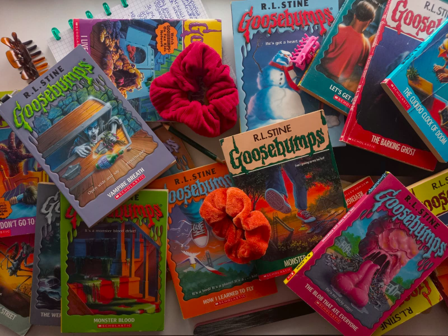

R. L. Stine’s Goosebumps may be just another nostalgic piece of 90s media for some, as they remember the creepy covers and formulaic plots of the books. But their trademark twist endings do more than deliver cheap thrills: they unsettle readers and even challenge the reliability of child narrators. This article takes a closer look at how the series balances predictability and surprise – and how this makes Goosebumps relevant today.
The height of the Goosebumps phenomenon might be long gone, but there’s a good chance that you’re still familiar with the franchise. Written by R.L. Stine, the series of children’s horror novellas dominated bookstores and book fairs throughout the 90s. In fact, it still ranks as the second best-selling book series of all time (unsurprisingly, the boy wizard takes the first place). Over the years, Goosebumps has expanded into video games, films, and television shows – most recently, a Disney+ series that was canceled this August (see Goosebumps, 2023). And for many, the original book series is a nostalgic piece of childhood media that is now getting re-examined from an adult’s perspective, as seen in YouTube videos like Reading All 62 Original Goosebumps Books in 1 Month Will Ruin Your Childhood (2021).
Beyond their iconic, shocking book covers, the books quickly reveal a structure that is built around twist endings. These endings became a series staple and are even referenced in the 2015 Goosebumps film: “Every story ever told can be broken down into three distinct parts: the beginning, the middle, and the twist.” Often, the twists surprise not only readers but also the child narrators themselves, which raises some interesting questions: How do these endings affect the children’s reliability – and how predictable is Goosebumps, really?
The formula of the books is simple. An ordinary twelve-year-old faces the monster of the week, usually without help from adults who dismiss their fears. In the span of 100 to 130 pages, they encounter the supernatural, confront it, and end up victorious. Stories are set in vaguely suburban small-town America, familiar to readers but often hiding unsettling secrets – like the locked basement in Stay Out of the Basement or the supposedly safe summer camp in Welcome to Camp Nightmare. Horror is never far away; it creeps into the everyday and hides in the dark corners at home. This makes it even more shocking when the supernatural rears its head, since it shatters the façade.
On to the tween protagonists, who can be summarized in a few sentences. These children are defined more by ordinariness than individuality, much like their middle-class nuclear families and their suburban house with the backyard. Usually, a family dog and an annoying younger sibling will complete the cliché. Occasionally, the setting of the story’s conception will shine through, when the children talk about their inline skates, their Game Boys and Super Soakers; this is 90s USA, no doubt. Gender rarely matters in Goosebumps: boys and girls alike are all tweens that are somewhere between shy and bratty, and decidedly pre-romantic, as the most they do is hold hands. Whiteness and able-bodiedness are the unspoken defaults, with any exceptions (like the African American character Lee in Attack of the Jack-O’-Lanterns) explicitly marked.
Adults and children are framed in strict opposition. Parents belittle or dismiss the children’s experiences, reinforcing a view of kids as innocent, clueless, and in need of protection. Even when the children are right about monsters, they lack authority: their warnings are waved off as harmless sibling rivalry, dramatic exaggeration, or ‘childish’ fears. As Tim Morris puts it, the Goosebumps hero is an “eternal twelve year old” (2000, pp. 76f.) stuck in an in-between stage with little power or agency. The adult-child opposition, while posed as problematic because it dismisses real fears, is still perpetuated in Goosebumps. But will its narrative situation continue this trend?
Goosebumps stories are almost always told in the first person by the child protagonist. This means the narrator, focalizer, and main character collapse into one position, with the child recounting what they see and feel as the spooky events unfold. As the narrator, the child is not omniscient: they hold limited information as it is tied to their personal knowledge of the world. Considering their lack of experience regarding the supernatural, the typical Goosebumps tween also has limited authority over the narration.
The twist endings perfectly exemplify this lack of control. Often, the final revelation is not foreshadowed at all, and both reader and protagonist are taken by surprise over what happens on the last page. In Go Eat Worms, multiple twists are happening as the main character, Todd, first finds out that he is not, as he previously assumed, terrorized by worms that want to take revenge on him – it was an elaborate prank played on him by his sister. But wait, there’s more! Suddenly, a giant worm appears out of nowhere, almost killing Todd. In response, Todd ends his worm-harming ways and turns to the peaceful hobby of butterfly preparation. The horror is not yet over as Stine strikes again on the final page, which sees a giant butterfly with a silver pin flying into Todd’s room.
These twist endings are truly unpredictable. The internal logic of Goosebumps allows for basically anything to happen; there is no “cohesive system of knowledge or faith or ethics that has the power to contain and control the randomness of reality” (Nodelman, 1997, p. 123). The child narrator can therefore never have certain knowledge of their world. Fundamentally, Stine’s protagonists “do not move from not knowing to knowing,” or even from “chaos to order” (Coats, 2001, p. 187). This unpredictability is reinforced on the chapter level. Almost every chapter ends with a cliffhanger, often a fake scare or prank. Parents will suddenly reveal they are monsters too, or a character screams that his face is falling off, only for the next chapter to immediately undo the tension. Readers quickly learn that while something shocking will always happen, its resolution might be very quick and painless. In this sense, surprise itself becomes predictable: we know to always expect the unexpected.
Narrators tell these moments very close to the action, despite the retrospective of the past tense that is used. As a result, the implied reader who expects a twist knows more than the child narrating, which leads to the question of how reliable the Goosebumps narrators are. They jump to conclusions and regularly overstate their certainty only to be proven wrong. They are not deliberately misleading, but they are continuously underreading situations because they don’t know better. Narrative theory offers terms for this: underreporting, misevaluating, and misreading. Gabe in The Curse of the Mummy’s Tomb mistakes his uncle for a mummy, even stating that he ‘clearly’ saw the monster. Manny in My Hairiest Adventure is equally sure that his skin is falling off. These lapses in judgment and subsequent heel turns mark the children as immature. They suggest that the tweens are not fully trustworthy narrators. The children’s narration might not be deliberately misleading, but they are continuously underreading situations simply because their perspective is limited. So, in addition to the parents’ disbelief, the narrative further takes away from the children’s reliability by framing the tweens as irrational and immature, unable to tell prank from reality.
But unreliability is a tricky concept, since judgments about truth depend heavily on the reader’s individual perception of a text. Common sense is not that common, and a problematic value scheme is only seen as problematic in contrast to one’s own values. As such, unreliable narration implies the existence of a reliable narrator, one who can bypass any natural human imperfections and have an objective view of the world (for more details, see Nünning, 2005). Often, narrators simply omit details because, in their world, nothing seems unusual. For example, Sammy in My Best Friend Is Invisible never mentions that he isn’t human, because in his society, no one is. Yet on another narrative level, the implied author is aware that readers think of the main character as human, which is why the reveal that Sammy is a non-human being constitutes a twist ending.
The model of unreliable narration has to go beyond relying on the subjective understanding of a reader. Unreliability requires signals of inconsistency in the text – signals that the author included so they would be spotted by the reader (cf. Nünning, 2005, p. 99). Examples of textual inconsistencies are conflicts between what the narrator says and their actions, internal contradictions in their discourse, or paratextual elements like the title. The title of The Girl Who Cried Monster references the fable “The Boy Who Cried Wolf,” thus cluing the reader in that the narrator speaks the truth but will not be believed due to past unreliable narrations.
Following the idea that unreliability requires clear textual signals, it can be said that Goosebumps provides very few. Initially. We are meant to believe the world is simple; “stranger danger” is passed over in favor of the horror hidden at home. And only the children see this truth! But then the twists destabilize the story’s reality, and they teach the reader that whether the narrator in question can be trusted to tell the truth or not is not recognizable in the text. Neither Todd nor the reader would’ve been able to see the sister’s prank or the giant worm coming!
Adding to that, framing child narrators as unreliable would echo how adults in the series dismiss children as irrational and untrustworthy. This is also indicative of real-world issues surrounding children’s safety, such as the aforementioned “stranger danger” that ignores how abuse often begins at home. Because who would believe a child who says an alien lives in their closet? The Goosebumps adults continuously frame the child protagonists as unreliable narrators, while the parents are constructed as believing themselves to hold moral superiority. Yet the text does not fully confirm the adults’ authority. Instead, the narrators are best understood as naturally limited by their age and perspective. Their voices are flawed, but not false, and it is exactly this limitation that makes the Goosebumps world so unstable and unpredictable. Again, the twist endings mess with the idea that the children know better than the adults and, in fact, raises the question of whether anybody knows what is going on in Stine’s stories. Reader beware: it’s a mess out there.


Leave a comment