Mampato is the main character of a nationally famous series of comics published in Chile during the twentieth century. However, if read under a new light, the stories might be perceived as problematic. What do we do with that?
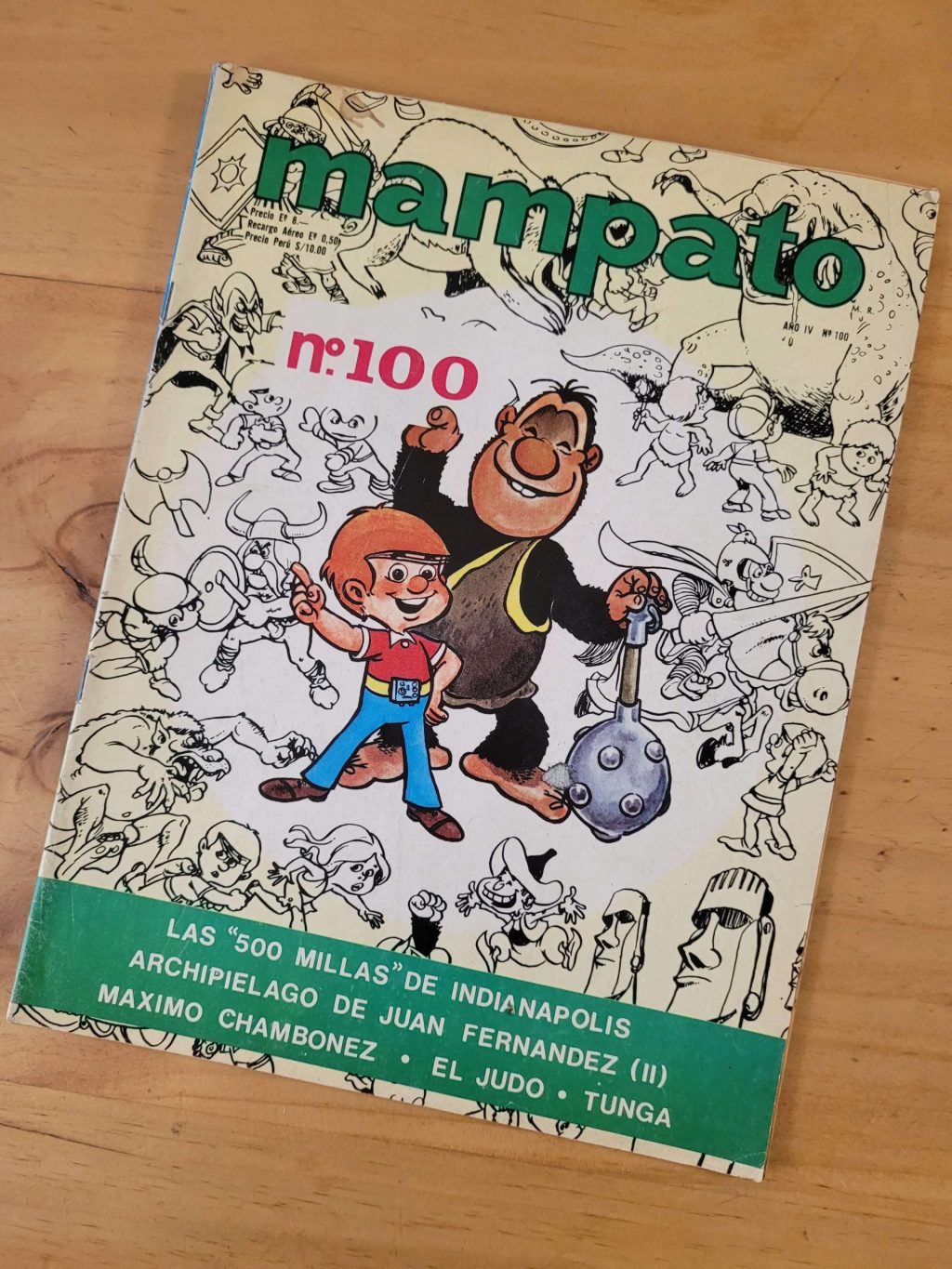
Bi-weekly magazines for children were a success in Chile during the 20th century. From the foundation of El Peneca (1908-1960), several periodic publications aimed to attract the attention of young people. Episodic comics, colourful illustrations, historical articles, school material and interactive games, among other content, were at the centre of these booklets sold in every kiosk. Barrabases (1954-) and Mampato (1968-1978) continued the legacy of that first magazine, with the main objective of entertaining and educating the new generations.
Mampato is the title of the publication project founded by Eduardo Armstrong in 1968. It is also the name of the main character of the central comic of the magazine, created by the caricaturist Oscar Vega and further developed by Themo Lobos. When they first began producing his adventures, they never imagined the impact that the small red-haired boy would have on Chilean popular culture. Neither that, after peaking in fame before Pinochet’s dictatorship, which led, in the end, to the magazine’s cancellation, his presence in the public mind would climax and then decay until it almost disappeared. Almost, because there is still a generation that reminds him with a sense of pride and a lot of nostalgia.
Who is Mampato?
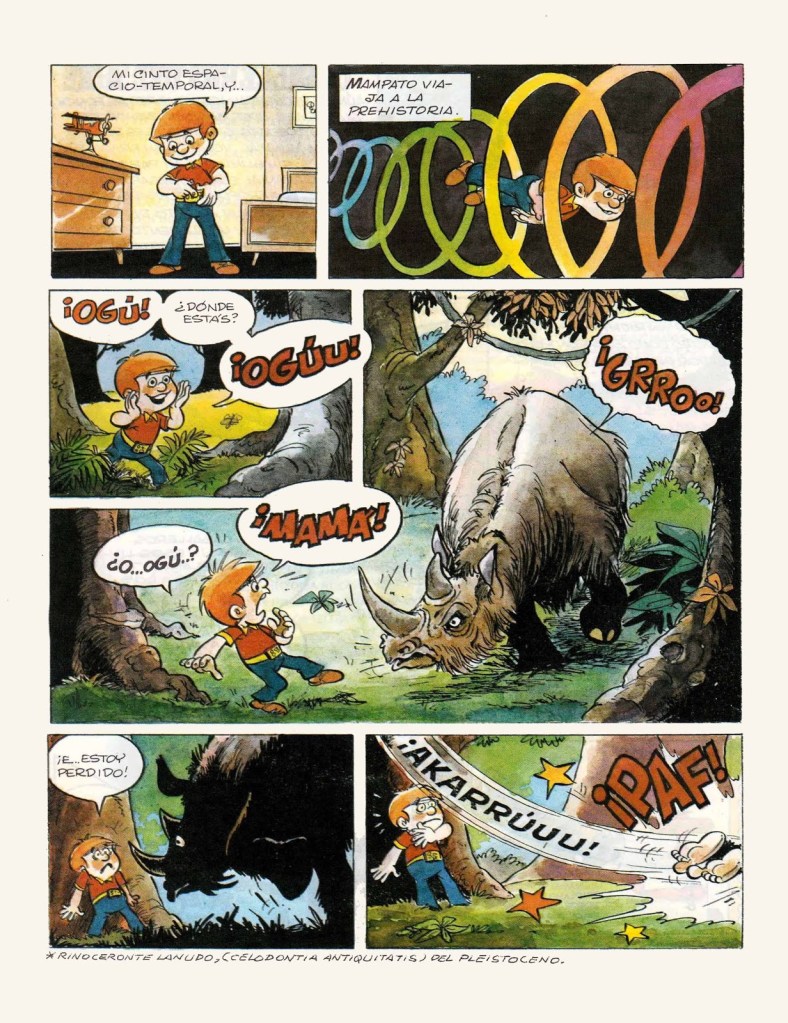
A 10-year-old boy called Mampato saves an alien from being eaten by a cougar. This is the introduction of the first episode of the comic featuring Mampato in the homonym magazine. He is depicted as a middle-class boy, red-haired, intelligent and curious, always wearing a red shirt and jeans. Xsé, the spatial foreigner, takes the boy with him to Xángus, his planet. There, they both fight Mong, the evil tyrant who had usurped the throne. After defeating the dictator, Xsé gives the boy a “cinto espacio-temporal” [tempo-spatial belt] as a token of appreciation. This artefact allows Mampato to travel through time to visit different cultures and live the most varied of adventures with Ogú, his prehistoric (and quite furry to be a hominid) best friend, and Rena, a telepath from the 40th century.
The different adventures that Mampato y Ogú would encounter due to the boy’s curiosity to see the world include a wide range of historical/fictional settings: Ancient Rome and Egypt, a dystopian future caused by a nuclear war (!), the Far West, Atlantis, Ogú’s prehistoric times, the Olympus, the Chilean Independence War period, a fantastic middle-east town related to Ali Babá, Camelot, among others. Rena would sometimes travel with them, using her powers to save the pair on multiple occasions.
It is relevant to note that, besides being brave and curious, Mampato was respectful to his parents, kind to his sister, responsible with his schoolwork, loyal to his friends, perseverant and clever when solving problems, and with a complex moral understanding that encouraged him to fight against injustices wherever he encountered them. Vega and Lobos created, in the end, the exemplary modern child that Chile needed. Their comics transmitted the values that, at the time, were culturally accepted and praised.
The building of a national character
Mampato’s adventures gained a lot of attention from children, but also from adults. More than 100.000 exemplars were printed of each number at the beginning of the ‘70s decade (Biblioteca Nacional de Chile, online). The magazine was a steady project with impressive revenue at this time. However, the economic and societal turmoil that triggered the coup d’etat by the military in 1973, and continued the next years, impacted the production capacity of the publisher and the audience’s ability to buy the magazine. Thus, with a print run of 7.000 exemplars and being no longer profitable, the project had to close.
The last number, published on January 25th 1978, did not mean the end of Mampato. Some of the stories were re-published in new children’s magazine projects (like Revista Ogú, Pimpín and Cucalón). The inauguration in 1975 of the amusement park Mampato in Lo Barnechea, Santiago, also contributed to maintaining the project’s presence and character in the collective memory. By the end of the ‘90s, the rights of the comics were sold, and most of the original adventures were printed as individual books. The re-edition of 32 of the 36 stories, by Dolmen and Sudamericana publishing houses, led to a sales phenomenon in Chilean libraries in the early 2000s.
In 2002, the comic Mata-ki-te-rangui was adapted into a cartoon film titled Ogú y Mampato en Rapa Nui [Ogú and Mampato in Easter Island]. The project had the sponsorship of El Mercurio –one of the most influential newspapers in the country– and the Ministry of Culture. The film won several prizes at international festivals (CineChile, online), which only led to an increase in Mampato’s presence in Chilean media. Toys, clothes, and collectable stamps, among others, were part of the merchandising available to the public. Even a laundry detergent had a promotion to acquire the books: if you bought the big box of detergent, you would get one of the comics. If you bought the small box, you would get a cardboard picture of one of the characters.
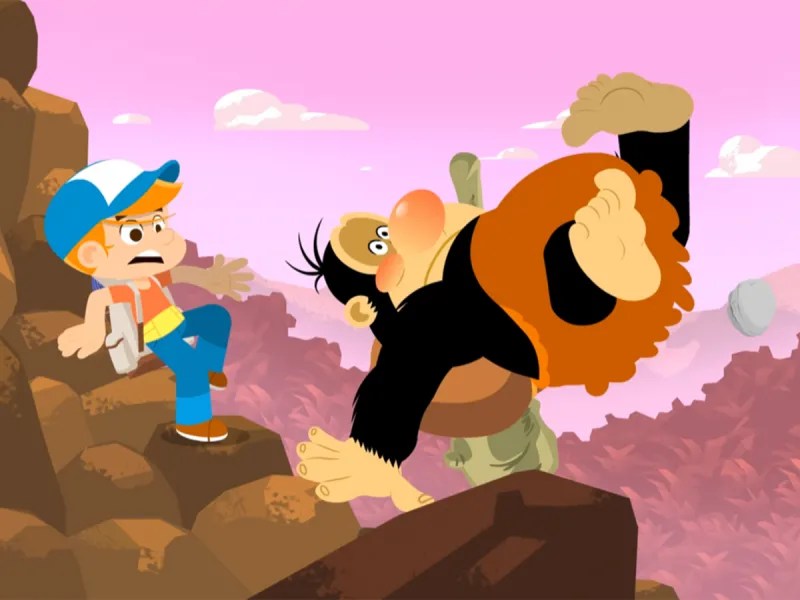
In 2018, a cartoon series that re-told the foundational tempo-spatial belt episode, plus the first four adventures, was titled Las aventuras de Ogú, Mampato y Rena. It has thirteen episodes, and even today is available through the CNTV (Chilean national TV platform) and Amazon Prime Video Latinoamérica.
Through all the above-mentioned adaptations, Mampato was re-shaped and thus saved from oblivion after the magazine was cancelled. By making the original adventures available to a larger audience through the re-tellings of the original stories (and conversion to new formats), a sense of cultural memory was built (Geerts and Van den Bossche, 2014). Mampato was a character that now, due to public recognition and engagement with the cultural products, formed part of the Chilean children’s literature canon.
The nationwide celebrations of the 50th anniversary of the Mampato magazine just added to the acknowledgement of this 10-year-old boy as a nationally valuable character. Luxury compilatory editions of the comics were published by Reservoir Books; the National Library presented an exposition of the characters, Vega and Lobos’ creative process and an intimate insight from the magazine headquarters; several reunions between fans from the blogs Generación Mampato and Logia Mampatiana were organized in Santiago; the Mampato amusement park opened new locations in different regions; and the news media (television, radio and newspapers) heavily covered the activities and created content around the character and his creators. As shown, Mampato’s presence was still expanding, even after years of the closure of the original periodical.
Remembrance and nostalgia
Mampato was famous and quite present in the collective imagination as was pointed out before. However, after 2019 not a lot has been published about the character or the series. Unlimited Comics, the last publishing house to have the rights to the complete collection –linked to the Copesa Group, which owns several newspapers and magazines in the country– stopped its operations that year. The cartoon series aired on open television, and that was the end of it. No more merchandising was made to be sold in book shops, nor even in specialised comic shops. The public was no longer looking for Mampato or Ogú’s products. The only derivative that still stands proud, but has lost the relation with the original reference, is the amusement park. Only the typography on the park’s logo extends a shadow over the first design of the magazine’s name.
After witnessing the decline, it is only fair to ask what the role of nostalgia was in the 2018 Mampato phenomenon. Are his adventures still appealing to contemporary children, or are the inner children of today’s adults the ones that keep his image alive? The answer is linked to the process of (de)canonisation, as presented by Kümmerling-Meibauer (2014): a reconsideration of the public’s conceptualisation of a work in the light of a different reception context.
New generations do not stand in the same place as children in the ‘70s. Variety and quantity are characteristics of the media that young people today engage with, which completely differ from the possibilities in the past century. A vast range of products exclusively developed with children as the main consumers exists from all over the world. Not only that, but technology has also changed the modality of consumption. Now it is not predominantly analogue but digital. The Mampato products are mainly printed on paper; they did not adapt to the digitalisation wave. They could not compete, as they were not updating their presence in public, just remembering how it was.
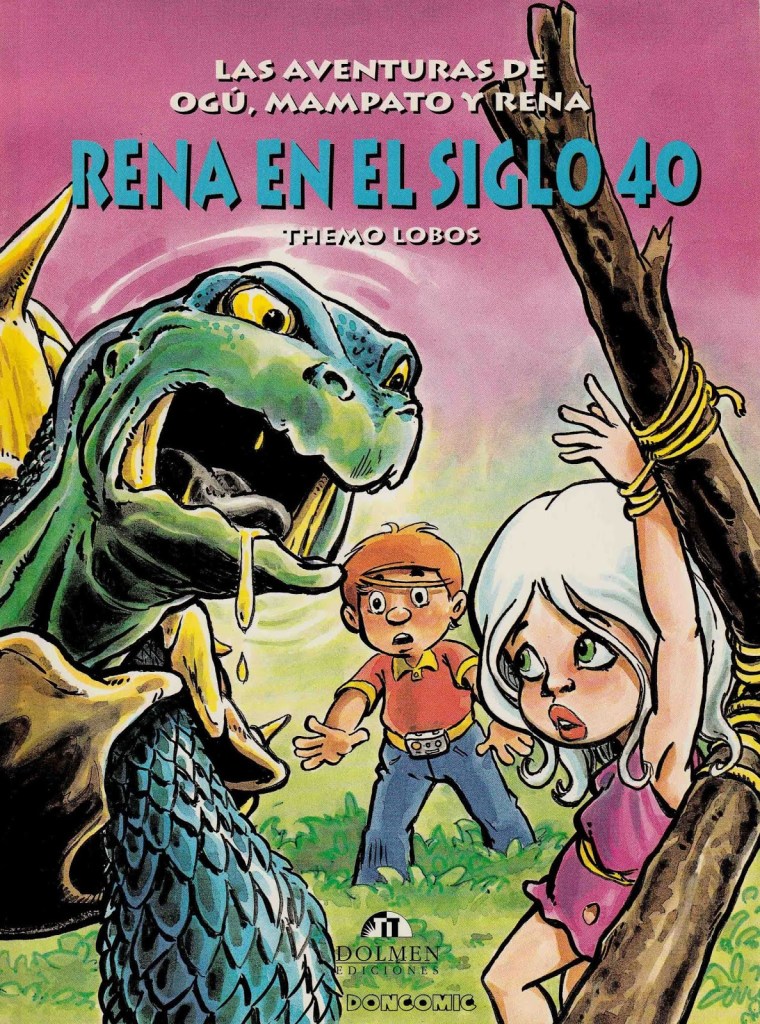
Moreover, some of the content of the adventures simply did not age well. What would society say nowadays about the hypersexualised 10-year-old Rena? She was introduced in Rena en el siglo 40 [Rena in the 40th century] as a damsel in distress about to be eaten by a gigantic mutant mole that Mampato and Ogú must save. The first vignette depicts her in a too-short dress, big breasts and small waist, red lips and eyeliner. After she is rescued, she kisses both men on the cheeks, which leaves Mampato completely in love with her. Afterwards, she takes part in some of the adventures with the other two characters –always in the too-short, too-tight dress–, being useful as a telepath and Mampato’s love interest. That is, actually, the role that fanfiction available on the web highlights: as Mampato’s bride in the future, as the mother of his child, not as a woman from the future who has a strong political opinion about the oligarchal abuse of society and who knows how to fight.
Another case that needs to be revised under contemporary lights is the patent racism in Mampato en el Congo [Mampato in the Congo] and El Marfil de los Matabekes [The Matabekes’ Ivory]. In his eternal curiosity, Mampato invites Ogú to visit Africa, specifically to explore the savannah and its animals. There, they encounter Ojo Mágico [Magic Eye], a hunter employed by the Belgian crown to capture the illegal poachers in the area. He is a white, refined man with a slim moustache dressed in kaki clothes and a hunter’s hat. The other helping characters are all colonial representations of African people: enlarged heads, pointy cheekbones, big white teeth, and massive pink lips. They only use spears, in contrast with the fire guns that the European characters (Magic Eye and the two antagonists, Smith and Wesson) have. Wamba, the kid who accompanies Mampato and Ogú, apart from the above-mentioned characteristics, only dresses with a loincloth. Though some people could say that not all the representation is outdated since there is a critique of slavery, it must be pointed out that Jones, the foreman of the plantation, is not taken into custody and brought to justice. He is violently killed by the former slaves with their spears. The last picture we have of him is a troubled one, surrounded by knives and angry African men. Then, silence.
“Are his adventures still appealing to contemporary children, or are the inner children of today’s adults the ones that keep his image alive?”
After commenting on the lack of updates in the modality and content of Mampato’s adventures, it is possible to say that the franchise failed to adjust to the receiving context (Geerts and Van den Bossche, 2014). They could not adapt to the ever-evolving ideologies and the new rhythm of society, not in the material nor the moral aspect. Though it has not been cancelled (yet, you never know…), problematic issues could arise if some projects were to revive the original story. Some of the comics, in fact, could not be published today without receiving backlash. Society now stands on moral ideas that fifty years ago were not concerning at all, thus making the evaluation of Mampato’s world completely different.
Does this change the historical value of Mampato and the role of its magazine in children’s culture during the ‘70s? Of course not. This analysis just broadens the discussion and prompts us to accept that culture is not static but a reflection of the times. If there is a conclusion to this article, it is that we should never stop questioning and reflecting on society and our history.
Geerts, S. and Van den Bossche, S. (2014). “Never-Ending Stories. How Canonical Works Live on in Children’s Literature” In: S. Geerts and S. Van den Bossche (eds.) Never-ending stories. Adaptation Canonisation and Ideology in Children’s Literature. Gent: Academia Press, p. 5-19.
Kümmerling-Meibauer, M. (2014). “(De)Canonisation Processes. E.T.A. Hoffman’s ‘The Nutcracker and the Mouse King’ and the Interfaces between Children’s and Adult Literature”. In: S. Geerts and S. Van den Bossche (eds.) Never-ending stories. Adaptation Canonisation and Ideology in Children’s Literature. Gent: Academia Press, p. 143-165.





Leave a Reply