

Author
Maria Dębska
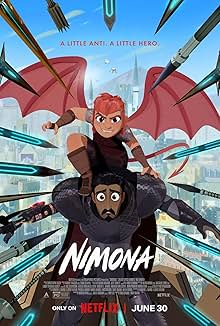
I came to watch Nimona expecting a clever animated fantasy and ended up experiencing a film that stayed with me much longer than I anticipated. Released on Netflix in 2023 and directed by Nick Bruno and Troy Quane, Nimona is based on ND Stevenson’s graphic novel by the same title. It is marketed as a family-friendly adventure/fantasy film, and on the surface it fits that label easily: there are knights, monsters, chase scenes, and a lot of fast-paced humour. But underneath all that, Nimona is a story about difference, fear, and what it costs to be yourself in a world that would rather you were not.
The film is set in a strange, hybrid world that feels both medieval and futuristic. At its centre is Ballister Boldheart, a knight-in-training who is framed for a crime he did not commit and quickly cast out by the institution he believed in. Enter Nimona, a shapeshifting teenager who decides—somewhat aggressively—to become his sidekick. Nimona can turn into almost any animal they want, often with chaotic enthusiasm, and they are immediately labelled a “monster” by the society Ballister once trusted in. The story follows their uneasy partnership as Ballister tries to clear his name and Nimona tries, in their own way, to be accepted. I will avoid major spoilers, but what matters most is not the plot twists themselves—it is how the film slowly shifts our understanding of who the real monsters are.
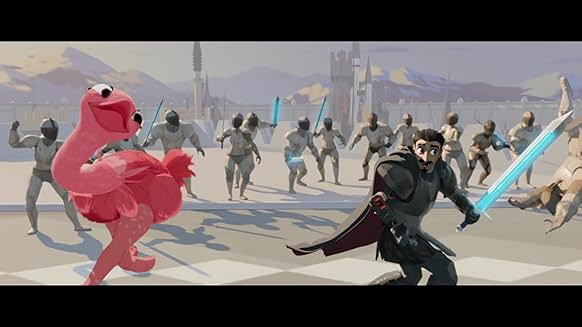
Once the characters are established, the visuals start doing a lot of quiet work. Nimona uses a mix of 2D and 3D animation that feels sharp, fast, and slightly restless. It makes the characters come to life perfectly. The animation keeps pulling the viewers’ attention forward, which is a fitting portrayal of a character who refuses to stay in one shape for long.
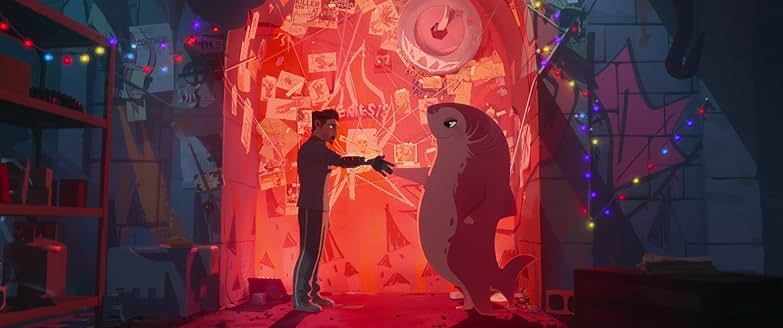
Colour, in particular, is being deliberately used in this film. On the one hand, the world around Nimona is mostly muted—greys, browns, cool metallic tones. It is a controlled world, visually and ideologically. Nimona, on the other hand, is bright pink. Always. Every animal they turn into carries the same pink colour, as if the film is insisting that no matter what form they take, their identity stays visible.
To me, that pink becomes one of the most important ideas of the film. Nimona cannot blend in, and the film treats that as a strength, not a flaw. When Nimona feels free, when they are joking, teasing, and allowed to exist as themselves, the colour feels joyful. When they are overwhelmed by fear and grief—when they try to suppress who they are—that brightness disappears. What replaces it is dark, heavy, and frightening. It is a simple visual contrast, with a high emotional impact.
Queer viewers will for sure read Nimona through that lens—even though the film itself never frames queerness as something forbidden. Ballister’s relationship with Ambrosius Goldenloin is openly romantic, and there is no moment where the story suggests that being gay is a problem in this world. And yet, as a queer viewer, I could not help but recognize familiar patterns in how their relationship unfolds. The secrecy, the hesitation, the way affection is expressed more carefully than it perhaps needs to be—all of it echoes real experiences of queer people navigating systems that were not built with them in mind. It is not that the film tells us they must hide; it is that many of us know what it feels like to do so anyway. That gap between what the story shows and what queer audiences can read into it is part of what makes the representation resonate.
Nimona themself is where that queer reading becomes harder to ignore. They are openly fluid in how they understand themself, playful with labels, and largely uninterested in explaining or justifying their identity to anyone else. Lines like “I’m not a girl, I’m a shark” work as quick jokes, but they also carry a quieter insistence: identity doesn’t need to be stable, consistent, or easily understood to be real.
What I appreciated most is that Nimona is not softened or idealized for a younger audience. They are witty, impulsive, sometimes cruel, and clearly shaped by past trauma.
Their messiness is not a flaw to be corrected—it is part of what makes them feel recognizably, insistently real.
Because of that, Nimona works surprisingly well as a film for children—not despite its complexity, but because of it. It offers a starting point for conversations about being different, about why fitting in can feel itchy and wrong, and about what happens when you sacrifice parts of yourself to make others comfortable. For families or educators who want to go further, it can also open discussions about gender fluidity and queerness without turning those topics into lessons or warnings.
One of the film’s quiet strengths is its insistence that understanding is not a prerequisite for care. You do not have to fully grasp someone’s identity to love them. Nimona does not want to be analysed or explained—they want to be seen. That idea feels especially relevant right now, when so many conversations about identity revolve around control rather than compassion.
The film is not perfect. Some emotional beats arrive quickly, and there are moments where I wished the story had lingered a little longer. But the performances—especially Chloë Grace Moretz as Nimona and Riz Ahmed as Ballister—bring warmth and sincerity that carry the film through its weaker moments.
Reviewing Nimona now feels necessary. At a time when children’s media are often expected to be safe, quiet, and unchallenging, Nimona takes a different approach. It trusts its audience. It allows its characters to be loud, strange, and uncomfortable. And it insists, again and again, that being visibly yourself—even when that makes others uneasy—is not something you should ever have to apologize for.
Maybe that is why the pink matters so much: in a muted world, it refuses to disappear.
Nimona is available to watch on Netflix.
 SLIDING MAGAZINE
Leave a comment