
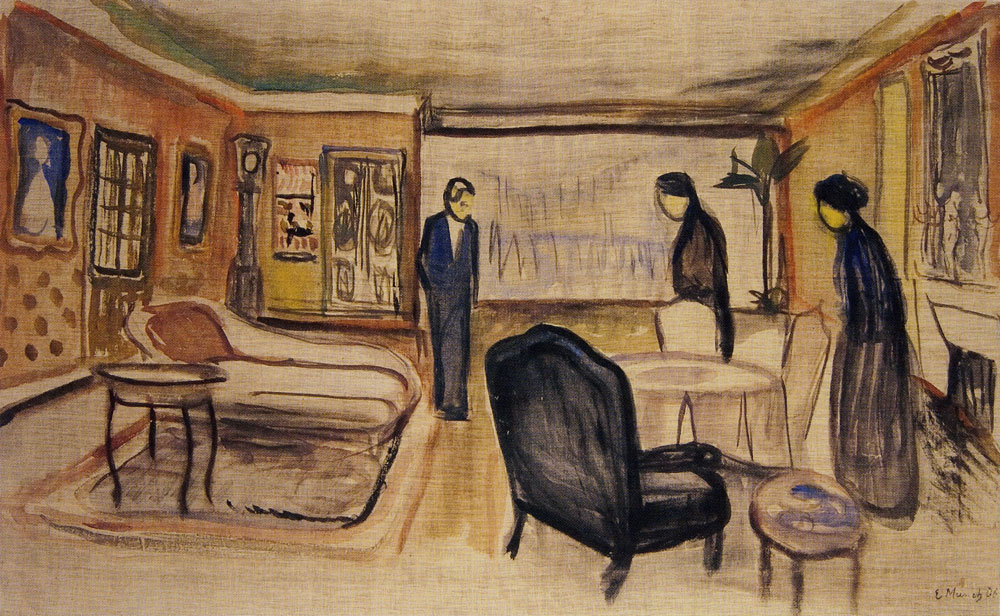

This essay explores how Ibsen’s Ghosts and Tagore’s The Laboratory depict children navigating inherited adult ambitions, moral expectations, and social pressures, highlighting the interplay of imagination, care, and intergenerational transmission across European and Indian literary worlds.
In Henrik Ibsen’s Ghosts (1881) and Rabindranath Tagore’s The Laboratory (1897), children are caught in a web of inherited narratives—moral, social, and ethical structures that the adult world projects onto them. These texts reveal that children are neither passive recipients of adult ideals nor mere observers; rather, they negotiate and internalise, and sometimes challenge, the intergenerational legacies imposed upon them. While the Scandinavian realist milieu of Ghosts emphasises the burdens of social morality and hereditary guilt, Tagore’s Bengali modernist drama portrays children as navigating domestic and ethical complexities shaped by cultural expectations, scientific ambition, and social hierarchy.
This essay argues that understanding children as active participants in inherited narratives—rather than passive recipients of adult ideals—offers insight into how literature shapes our perception of childhood. The Ibsenite and Tagorean child, caught between worlds, embodies both the possibilities and constraints of being socialised into inherited dreams, suggesting that adult ambitions inevitably ripple through the imaginative landscapes of the young, across continents and cultures.
Children and Inherited Narratives
Ibsen’s Ghosts presents children as acutely aware of inherited moral and physical legacies. Oswald Alving, the son of a morally compromised father and a dutifully pragmatic mother, inherits not only his father’s syphilitic condition but also the social burdens associated with bourgeois respectability. In one extended passage, Oswald reflects:
“I know now that the past is never gone, that every act, every silence, haunts us. My father’s secrets were meant to remain buried, yet they rise in my veins and demand reckoning. Even as a child, I felt the shadow of what was not spoken pressing upon my conscience. I tried to play, to be like other boys, yet everywhere I went, the weight of what I had inherited followed me. It is not merely the disease; it is the judgment, the fear, the unrelenting gaze of morality that watches through me.”
The repetition of words such as “inherit” and “shadow” emphasises the inevitability of adult influence, while phrases like “every act, every silence” underscore how children internalise social norms long before they can comprehend them fully. Oswald’s play is disrupted by these moral and physiological legacies, illustrating how children’s imaginative and ethical development is inseparable from adult narratives.
Similarly, in Tagore’s The Laboratory, children inhabit a space charged with adult power and desire, though these are mediated differently. Rebati observes her mother, Sohini, as she manipulates chemical substances, an act that is at once scientific and ethical:
“Rebati stood behind the screen, her small hands gripping the edge, eyes wide as Sohini mixed the powders. The room smelled of earth and metal, and Rebati could not decide whether it was fear or fascination that quickened her pulse. She wanted to touch, to test, to know, yet she knew that one wrong move could undo everything her mother had laboured for. And so she watched, learning the rhythm, the patience, the authority embedded in the smallest gestures.”
Here, Tagore dramatises the child’s learning as both ethical apprenticeship and imaginative engagement. Unlike Oswald, who is burdened by secrecy and inherited guilt, Rebati engages with curiosity tempered by recognition of responsibility. The close reading highlights the sensory and spatial awareness—the “smell of earth and metal,” the “small hands gripping the edge”—as mediums through which the child absorbs adult knowledge, illustrating the permeability of the child’s imagination to ethical and scientific frameworks.
Negotiating Constraints and Possibilities
Both Oswald and Rebati negotiate inherited constraints with differing forms of agency. Oswald’s ethical dilemmas manifest in his awareness of his parentally imposed destiny:
“I could not act, though I longed to change the course my parents had set. I sat among the toys I once cherished, trying to recall a moment when the world was mine to shape, yet every memory carried the imprint of their desires, their disappointments, the unspoken rules I could never escape.”
The interplay between physical play and moral entrapment underscores how Ibsen situates children’s agency as both internally and externally constrained. Oswald’s imaginative engagement with play is interrupted by knowledge and fear, rendering the child a co-creator of inherited moral narratives, but within limits set by adult expectation.
Rebati, in contrast, negotiates freedom within structure. Her observation of Sohini’s actions allows her to experiment mentally with ethical reasoning:
“She imagined herself as the master of the laboratory, as if the powders obeyed her alone. But the thought brought both exhilaration and dread; she could not forget that power carried consequence. When she finally lifted the vial, trembling, she felt both the thrill of possibility and the weight of inherited knowledge.”
The child’s imaginative capacity becomes a site of ethical rehearsal. Tagore portrays the child as learning through simulated agency—Rebati enacts possibilities in the safety of observation, reflecting on adult ethics before engaging with the material world. This contrasts with Oswald, whose ethical engagement is imposed retroactively by heredity and secrecy. Both cases demonstrate how children navigate inherited narratives by internalising, negotiating, and at times resisting adult frameworks.
Cross-Cultural Resonances
The interplay between Scandinavian realism and Bengali modernism illuminates shared concerns about children’s socialisation alongside culturally specific tensions. In Europe, Ghosts situates childhood within a critique of bourgeois morality and hereditary disease, reflecting anxieties about social propriety, family legacy, and moral accountability. In India, The Laboratory situates childhood within a nexus of domesticity, scientific ambition, and ethical apprenticeship, reflecting concerns about social reform, ethical development, and educational transmission.
Consider the following juxtaposed passages:
Ghosts:
Oswald could not speak; he only watched as his mother moved through the parlor, placing lamps and letters, performing rituals of order. Each gesture seemed to echo centuries of expectation, and though he was a child, he understood their weight. The shadows of ancestors, the silent gaze of neighbors, and the moral arithmetic of his father’s actions pressed upon him relentlessly.
The Laboratory:
Rebati mirrored her mother’s movements, aligning her own small gestures with the precise measures of powders and vials. She did not touch without permission, but each observation was a rehearsal of the future, a map of ethical action laid bare in adult form.
In both texts, children observe adult labour and inheritance as formative. The key difference lies in the imaginative response: Oswald internalises a burden, while Rebati simulates and rehearses ethical engagement. Both, however, demonstrate children’s active negotiation of adult narratives and the shaping of imaginative landscapes by inherited expectations.
Ethics, Imagination, and Agency
Literature positions children as active participants in the formation of moral and imaginative landscapes. In both Ghosts and The Laboratory, children absorb adult anxieties, ethical norms, and social expectations, yet also transform these inheritances through reflection, imagination, and negotiation.
In Ghosts, Oswald’s internalisation of moral and hereditary constraints reflects a tension between ethical awareness and helplessness: “I am trapped by what I did not choose, yet even in my inability to act, I learn the rules, the codes, the unspoken logic of this household. My play is colored by calculation, my laughter by knowledge I cannot unlearn”.
In The Laboratory, Rebati’s observation functions as an ethical apprenticeship: “Her eyes followed every line of Sohini’s hand, every deliberate pour. She imagined herself making decisions, facing consequences, testing moral boundaries within the safety of observation. The laboratory became a stage upon which adult desires and responsibilities intersected with her curiosity and ethical imagination”.
These passages demonstrate that children mediate between inherited norms and personal agency. Imagination and ethical reasoning are inseparable from inherited narratives, but children also enact small-scale negotiations that shape the ongoing story of social and moral development.
Conclusion
Ibsen and Tagore offer complementary visions of childhood as active engagement with adult legacies. Across the European and Indian contexts, children inhabit spaces shaped by inherited dreams, moral imperatives, and social expectations. The Ibsenite child internalises and negotiates burdens of heredity and morality, while the Tagorean child rehearses ethical action and curiosity within culturally and scientifically mediated frameworks.
Understanding children as co-creators of inherited narratives reveals the imaginative and ethical labour involved in growing up. These texts illuminate the ways adult ambitions ripple across childhood imagination, offering insight into cross-cultural approaches to pedagogy, ethics, and the literary construction of childhood. The child at the edge of adult dreams navigates inherited narratives with both constraint and creativity—a negotiation that resonates across continents, time periods, and literature.
Bibliography
Primary Sources:
- Ibsen, H. (1881) Ghosts. Translated by W. Archer. London: Methuen, 1890.
- Tagore, R. (1917) The Laboratory. In: Tagore: Plays and Short Stories. Translated by S. Sen. Calcutta: Macmillan, 1923.
Secondary Sources:
- Ledger, S. (2008) ‘Ibsen, Realism and “Modern” Drama: From Norwegian Nationalism to Ghosts’, Cambridge Companion to Ibsen, Cambridge: Cambridge University Press, pp. 15–25.
- Törnqvist, E. (1994) ‘Ibsen on Film and Television’, The Cambridge Companion to Ibsen, Cambridge: Cambridge University Press, pp. 205–216.
- Tjønneland, E. (2025) ‘Ibsen and Degeneration: Familial Decay and the Fall of Civilization’, Ibsen Studies, 25(1), pp. 59–82. https://doi.org/10.1080/15021866.2025.2499792
- Mukherjee, P. (2022) ‘Strangeness and The New Woman: Rereading Rabindranath Tagore’s The Laboratory’, in: Tagore beyond Borders, London: Routledge, pp. 111–123. https://doi.org/10.4324/9781003228745-10
- Mukherjee, D. and Holt, X. (2024) ‘Willy Haas in Bombay’, BioScope: South Asian Screen Studies, 15(1), pp. 59–67. https://doi.org/10.1177/09749276241253498
- Kinnvall, C. (2012) ‘European Trauma: Governance and the Psychological Moment’, Alternatives: Global, Local, Political, 37(3), pp. 266–281. Available at: http://www.jstor.org/stable/23412513 [Accessed 9 Oct. 2025]
About the author
Z.I. Mahmud is an ICCR Fulbrighter and English alumnus of Satyawati College, University of Delhi, India, and an independent researcher based in Bangladesh. His areas of interest merge transnational comparative research linking global modernism, reception studies, and transcultural literary reinterpretation. His most recent publication, “Ecocosmic and Cybernetic Femininities: Posthuman Metamorphosis in Wuthering Heights and Great Expectations” (in Emerging Trends and Future Directions in Comparative Literature, ed. Dawle et. al., 2026), and his ongoing conference presentations engage questions of materiality, embodiment, and afterlives across literary and cinematic forms.
 SLIDING MAGAZINE
Leave a comment