


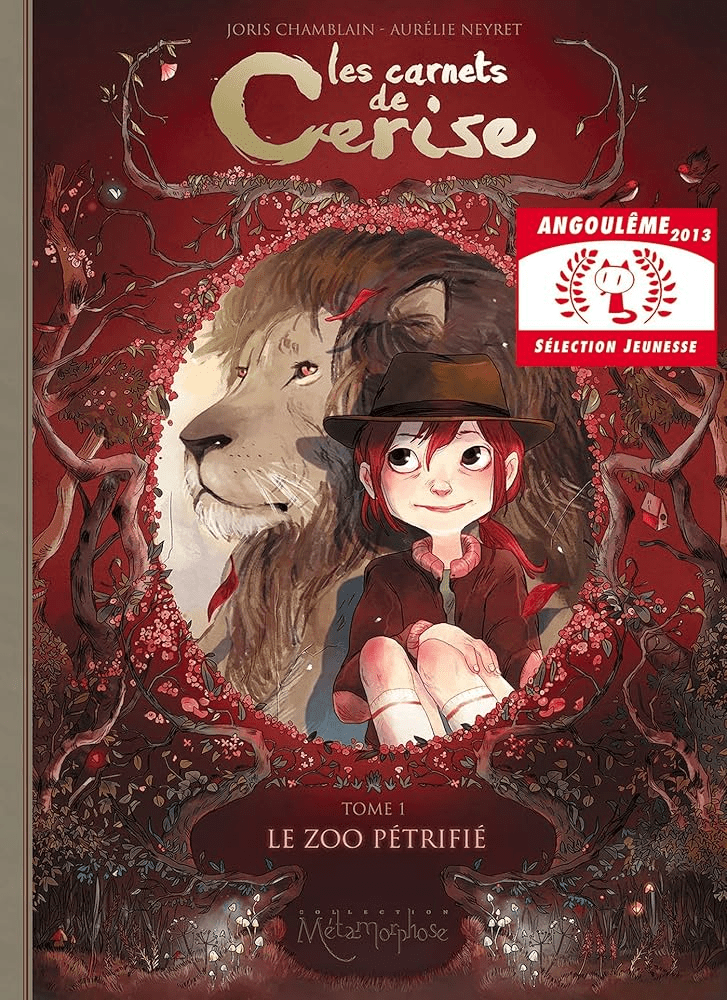
Les Carnets de Cerise: Le Zoo pétrifié (2012) follows the ten-and-a-half-year-old aspiring writer Cerise. In fictional diary form, she tells her stories. In this review, I discuss the aspects of the diary and how to relate to this graphic novel.
I will not lie, when the theme of this issue – biographical media – was picked, I struggled with deciding on what to write. After all, I am a fiction reader at heart and soul. Then I realised there is one form of fiction writing I adore: the inclusion of letters, diary entries, etc. So, while this issue is about biographies, I aim to highlight the entertainment and creativity of fictional diaries in this review.
The diary is a popular form of life writing. Following Philippe Lejeune’s description in On Diary, various characteristics are specific to the medium. The physical diary is often written in a notebook or on loose pages where the writer feels free to make “spelling mistakes or be stupid.” He adds that an honest diary is “discontinuous,” “full of gaps,” “redundant and repetitive,” and “is not constructed like a story with a beginning, a middle, and an end.” He also writes that dated entries, which record the author’s thoughts and experiences, are essential for a text to be considered a diary. Although the diary is a private piece of writing, Lejeune acknowledges writing his “readerless diary as though there was a reader.” This seems to change the idea that the meaning of a diary is never fully available to the reader. It is assumed that the author’s memories connected to the diary entries are important in the meaning-making of the full story (Lejeune, 2009). Diary entries are not only part of life writing, but they are also included in various works of fiction.
This review analyzes the strategies used to create a fictional diary entry in Chamblain and Neyret’s Les Carnets de Cerise (2012). The six-part comic series, available in English as Cici’s Journal, follows the young aspiring writer Cerise. The first part, Le Zoo pétrifié (2012), follows the ten-and-a-half-year-old Cerise on her investigation of an old man who crosses the forest with cans of paint every day. In her diary entries, Cerise writes about her life, her memories, and her discovery. The wholesome story is accompanied by beautifully colorful illustrations. If you ask me, this series is the embodiment of the cozy mystery genre.
Before looking at the written words, two things are instantly noticeable about the diary page. Firstly, a striking feature of this entry is the absence of a date. All diary entries in this comic lack a date on the page. Secondly, in line with the statement of Lejeune, the diary is written on loose pages. The physical form is recognizable through the lined paper on top of a sheet of graph paper. While Cerise’s entry shows no mistakes, the scrapbooking— visible through the taped-down leaf— and the doodles show that the fictional character sees her diary as a place to freely explore her creativity.
When analyzing the written text, the entry shows more seriousness. Rather than being written without a reader in mind, the diary is used to fill in the gaps that are left by the comic pages. As a result, the meaning of the narrative is fully available to the reader. Because of the importance of the plot, the diary is continuous, lacks gaps, and shows little repetition. The entry does show rhetorical divisions by having Cerise divide her written work into various paragraphs. When reading the full five pages of the diary entry, they show thematic division. On each page, Cerise introduces a different aspect of her life, including herself, her mother, and her best friends.
This analysis leaves the following question: Can Cerise’s diary still be considered a diary when it displays so few of the genre’s defining characteristics? From this excerpt, it is presumed that Cerise uses her diary with the intention of publication rather than for memory-keeping purposes. Perhaps writing a text with the intention of it being a diary, as mentioned by Cerise herself, is all that is needed for a piece of life writing to be perceived as a diary.
Bibliography
- Chamblain, J., & Neyret, A. (2012). Les Carnets de Cerise. Soleil.
- Chamblain, J., & Neyret, A. (2017). Cici’s Journal: The Adventures of a writer-in-training. First Second. Silvester Strips.
- Lejeune, P. (2009). On Diary (J. D. Popkin & J. Rak, Eds.; K. Durnin, Trans.). Published for the Biographical Research Center by the University of Hawaiʻi Press.
 SLIDING MAGAZINE
Leave a comment