
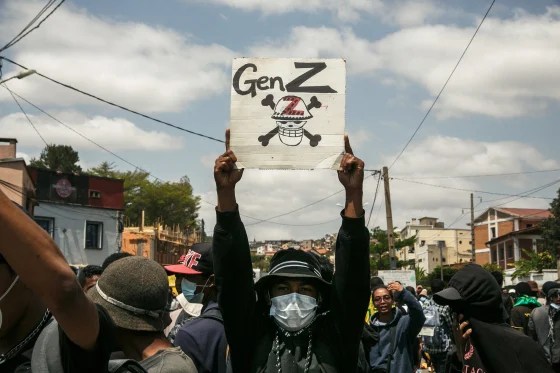

Gen Z-led revolutionary movements have recently caught the attention of the media, partly due to their innovative approach to protests and politics. Whether in Indonesia, Nepal, Madagascar or Morocco, young people have relied on similar symbols to showcase their opposition. Among those, One Piece’s pirate flag and The Hunger Games’ salute have even become an emblem for freedom across the globe. But can children’s literature and media actually have an influence on young people’s political agency?
Gen Z-led revolutionary movements have recently caught the attention of the media, partly due to their innovative approach to protests and politics. Whether in Indonesia, Nepal, the Philippines, Madagascar or Morocco, Gen Z youth have relied on similar symbols to showcase an opposition to their respective governments. These references tend to be derived from a shared popular culture, thus pointing to a seemingly cohesive movement which is developing across borders, with members from various contexts learning from one another’s experiences through a digital space. One symbol in particular appears to be ubiquitous: a flag featuring a smiling skull wearing a straw hat with a red ribbon. Whilst it may look like a simple Jolly Roger, connoisseurs would recognise it as the flag of the Straw Hat Pirates, a symbol of freedom in the famous One Piece series by Eiichiro Oda. What is striking about those events stands less in protesters’ reliance on popular culture or media to convey political messages than in their reliance on the very same symbol to convey their message. Easily identified, understood and replicated, this symbol played an important role in recent protests across the globe, prompting us to question the impact that children’s literature and media can actually have on young people’s political agency. So let’s dive deeper into the agentic use of YA references by Gen Z protesters across the globe…
The appropriation of the three-finger salute by Thai protesters
Just like the One Piece franchise, references to The Hunger Games one have empowered young people across the globe to take direct political actions, playing a central role in several major protest movements including in Thailand.
In 2020, many Thai children and high schoolers were seen flashing a three-finger salute as a symbol of support of the student-led protests against the antidemocratic government of General Prayuth Chan-ocha. Easy to identify and imitate, this gesture spread like wildfire among the crowds of protesters who marched the streets of the country that year.
Interestingly enough, this sign is the same that Katniss Everdeen uses to rebel in The Hunger Games, a dystopian YA trilogy by Suzanne Collins, in which the young protagonist sparks a revolution against a violent totalitarian regime. In these books, the ruling class organises an annual TV show in which twenty-four teenagers battle to death for the entertainment of the elite, their sacrifice standing as a reminder of their districts’ failed attempt at rebellion. The powerful symbolism of the salute has not been lost on Thai youth, who identified with the oppressed in the series.
The meaning of the three-finger salute in the canon
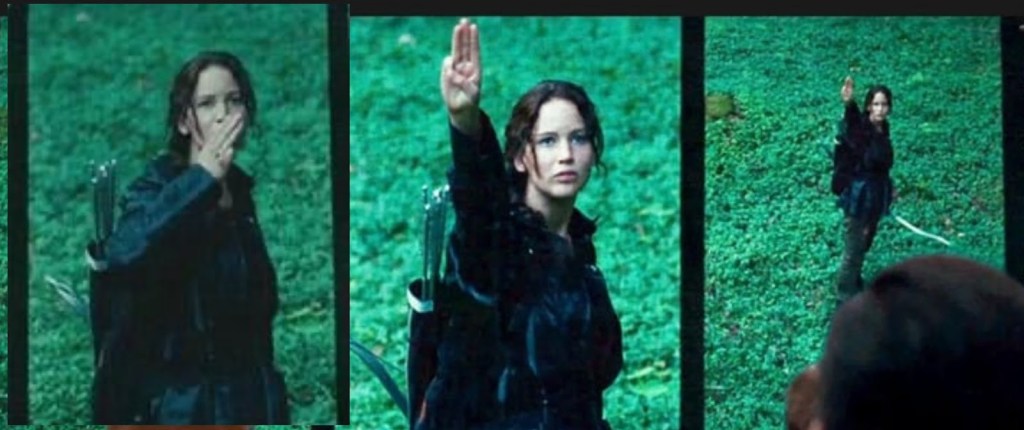
As acknowledged by protesters (1), this three-finger salute is a direct reference to The Hunger Games, in which it first appears as a means of silent protest against the ruling class. This moment occurs during the Reaping, the time of year when the elite of the Capitol travels to the twelve districts of Panem in order to select the tributes who will be forced to fight to death. When her little sister is selected, Katniss decides to intervene and to volunteer as a tribute instead, an act of bravery which is met with a silent sign of admiration from the people of her district. The scene is described in the following terms by Collins:
‘Come on, everybody! Let’s give a big round of applause to our newest tribute!’ thrills Effie Trinket.To the everlasting credit of the people of District 12, not one person claps. […] I stand there unmoving while they take part in the boldest form of dissent they can manage. Silence. […] Then something unexpected happens […]. At first one, then another, then almost every member of the crowd touches the three middle fingers of their left hand to their lips and holds it out to me. It is an old and rarely used gesture of our district, occasionally seen at funerals. It means thanks, admiration, it means good-bye to someone you love (Collins, 2008).
But this sign, which goes on to take a greater importance throughout the series as it becomes a symbol for the liberation of the oppressed, mostly gained in popularity when it was brought to the screen and turned into a major international phenomenon. The scene in which Jennifer Lawrence, starring as Katniss Everdeen, flashes the sign after the death of one of her rival tributes, is perhaps the most famous image of this three-billion-dollar franchise (2). By the time the secondmovie was released, the three-finger salute had become a well-known symbol of resistance within pop-culture (3).
An online-based movement
As the books and movies were released, Tumblr emerged as one of the main online spaces in which fans could discuss the series. This online community eventually led to the creation of activist campaigns such as “Odds in our Favor“ which, among other projects, encouraged fans to tap into the iconography of the three-finger salute as a means to protest against economic inequalities (4). In the face of an increasingly authoritative government in Thailand, the sign was repurposed by activists to demand more democratic rights. In doing so, the fans of this YA transmedia franchise outgrew their position as passive consumers and instead exercised their digital agency by actively participating in the production and circulation of media (in what Jenkins calls participatory culture (5)). In doing so, they endowed Collin’s salute with a meaning of their own.
But what is the connection between The Hunger Games and Thailand’s political context at the time?
The film release was shortly followed by the 2014 coup d’état in Thailand, placing General Prayuth Chan-ocha at the head of the government. The sudden instigation of a martial law, of a military junta and of the violent repressive episodes that followed pushed Thai citizens to draw parallels between the dystopian country of Panem and their own (6). Subsequently, the famous Hunger Games salute was widely appropriated by protesters as a sign of opposition to the military junta and its antidemocratic principles. As a matter of fact, it became so popular that the National Council for Peace and Order eventually forbid its display altogether and censored the third movie (7).
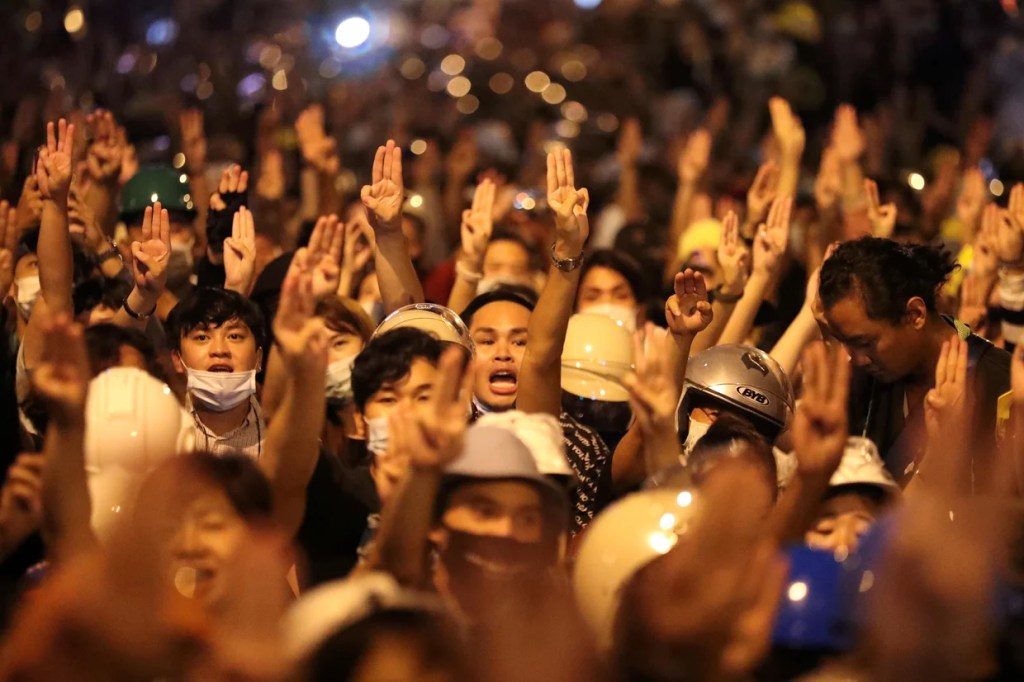
Ten years later, the gesture still held a lot of power in Thailand, and was massively used during protests in 2020 (8). The longevity of this sign in Thai protests is undoubtedly due to the increased authoritarian rule imposed by Prayuth Chan-ocha. After the dissolution of yet another opposition party, Future Forward, in February 2020 and the abduction of Wandchalearm, a vocal government critic, the famous salute gained renewed attention, as it was brandished again by students (9).
“By telling their readership about violent regimes in metaphorical terms, these texts require young people to make parallels between fictional injustices and already existing ones, thus granting them the tools to understand what systemic oppression can look like.”
Young people in Thailand, who had grown up reading The Hunger Games under military rule, reclaimed the sign once again as a symbol of their fight for democracy. Their rallying symbol, first flashed on university campuses, was quickly adopted in high schools and even primary school playgrounds during the recital of the national anthem. Interestingly, the display of this YA literary emblem grew viral on social media and succeeded in drawing global attention to the struggles of Thai citizens, thus inviting one to reflect on the role played by stories about resisting dictatorial regimes, however far removed from our reality as they can seem. By telling their readership about violent regimes in metaphorical terms, these texts require young people to make parallels between fictional injustices and already existing ones, thus granting them the tools to understand what systemic oppression can look like. On the topic, Hintz and Ostry (2003, in Ames, 2013, p.7) write : “In general, utopian and dystopian literature encourages people to view their society with a critical eye, sensitizing or predisposing them to political action”.
What do these protesters tell us about the political agency of young people?
What this case study illustrates is not the ‘power of literature’ – an often-used yet cliché concept – but rather the power of young people, who have demonstrated time and time again their bravery and resourcefulness by making agentic use of widely known media in order to effectively convey their political beliefs. It is by exercising their literacy skills to fictional texts, social media and their political environment that these young people were able to endow Collins’ three-finger salute with a new meaning which was instrumental in tangibly altering their country’s political landscape (Read more about different kinds of literacy here in our first issue).
But how can we explain the efficiency of using such symbols in protests?
Although the actual influence which these references to children’s and YA texts have had within political movements is difficult to assess, the prohibition of the three-finger salute and the censorship of the third TheHunger Games movie release in Thailand point to the efficiency of such initiatives. Here is why relying on such symbols for political purposes is genius:
- It is a potent signal whose meaning is widely understood. In the age of globalisation, audiences of children’s and young adult narratives have grown substantially, and are not necessarily limited to certain linguistic contexts. The first The Hunger Games movie (2012) alone earned more than $694 million worldwide in box office (10), making it readily accessible to a significant portion of young people across the globe. But the three-finger salute is not solely identifiable by those millions who are acquainted with the books or movies. Indeed, global phenomenons such as this one are so ubiquitous that they have successfully permeated our cultural and digital discourses. This is crucial, because it makes the three-finger salute a readily-understandable symbol for anti-democratic policies across the globe, and more likely to gain international traction. Not only do such symbols enable young people to efficiently denounce the oppression which they are experiencing but they also enable them to quickly identify the struggles of others.
- It is an indirect and therefore safer denunciation of authoritarian governments. Because many of these protests are occurring in anti-democratic contexts, these symbols are a safer way for protesters to express their discontent, as they can hardly be considered a direct attack against the government. And while these signs are widely understood by the target audience of the media in question, they are not necessarily known to local authorities, and can therefore remain under the radar for longer than references to adult literature – such as the works of Margaret Atwood or George Orwell.
- They are easy to identify and replicate. Effective symbols such as One Piece’s pirate flag or the three-finger salute are remembered for being simple yet visually striking. They effectively convey powerful messages but require minimal preparation. The salute especially can be easily done, and one hand could hardly be identifiable within a crowd, which may explain its popularity amongst activists.
Conclusion
Young people are often said not to engage in traditional politics enough, and the main factors for that are a lack of civic literacy (Ames, 2013) and a disconnection from traditional sources of media (Barnhurst, 1998). However, these examples demonstrate the ability of Gen Z to effectively lead major protest movements across entire countries, when they are given the opportunity to draw parallels between their situation and the media that they consume. References to children’s and young adult narratives thus become a lens through which they interpret and grapple with their reality.
Whilst it would be incorrect to assimilate young people across the world under one category, a significant portion of Gen Z have grown up around the same, overwhelmingly Western cultural references and share digital literacy skills. From this perspective, it seems that combining those two playgrounds – through memes for instance – is a fantastic yet largely unexplored activist strategy to effectively raise young people’s political awareness as to their struggles and those of others.
Bibliography
Primary Sources:
- Collins, Suzanne. The Hunger Games Trilogy. New York: Scholastic Press, 2008.
- Ross, Gary et al., dir. The Hunger Games. 2012; Santa Monica, USA: Lions Gate Home Entertainment, DVD.
Secondary sources:
- Ames, Melissa. “Engaging ‘Apolitical’ Adolescents: Analyzing the Popularity and Educational Potential of Dystopian Literature Post 9/11“. The High School Journal. 97, no. 1 (2013): 3-20. Accessed May 6th, 2024. https://www.jstor.org/stable/43281204
- Associated Press in Bangkok. “Hunger Games Salute Banned by Thai Military”, The Guardian, June 3, 2014. https://www.theguardian.com/world/2014/jun/03/hunger-games-salute-banned-thailand
- Box Office Mojo. “The Hunger Games (2012). https://www.boxofficemojo.com/title/tt1392170/
- Campbell, Charlie. “Hunger Games Salute Becomes a Real Sign of Dissent in ‘Tyrannical‘ Thailand.“. The Time, June 3, 2014. Accessed June 1, 2024.
https://time.com/2816496/hunger-games-salute-becomes-a-real-sign-of-dissent-in-tyrannical-thailand/ - Financial Times. “Why Young People Are Protesting in Thailand | FT?“, Financial Times, September 18, 2020, Video, 3:12, https://youtu.be/K6ksDjOUOvs?si=CE_qIeVvDg-2WvrF
- Harberkorn, Tyrell. “The Fight For Democracy in Thailand“. Dissent Magazine. October 21, 2020. Accessed June 1, 2024.
https://www.dissentmagazine.org/online_articles/the-fight-for-democracy-in-thailand/ - Hui, Annie. “Appropriating Dissent: the Three-Finger Salute and Thailand’s Pro-Democracy Movement“. Anthropological Notebooks 26, no.1 (2020): 74-91. Accessed June 1, 2024.
https://anthropological-notebooks.zrc-sazu.si/Notebooks/article/download/94/72/311 - Jenkins, Henry, Purushotma, Ravi, Clinton, Katie, Weigel, Margaret, & Robison, Alice J. Confronting the Challenges of Participatory Culture: Media Education for the 21st Century. Cambridge: The MIT Press, 2006. Accessed June 1, 2024.
https://www.macfound.org/media/article_pdfs/jenkins_white_paper.pdf - Kyaw Win, “Hunger games ‘Three Fingered Salute‘ Now A Widely-Used Protest Symbol in South East Asia“ CBS News, May, 12, 2021, https://www.cbsnews.com/news/myanmar-hong-kong-democracy-hunger-games-3-finger-salute/
- Nash Information Services, LLC, “Box Office History for Hunger Games Movies“, The Numbers, Accessed June, 1, 2024, https://www.the-numbers.com/movies/franchise/Hunger-Games#tab=summary
 SLIDING MAGAZINE
Leave a comment