
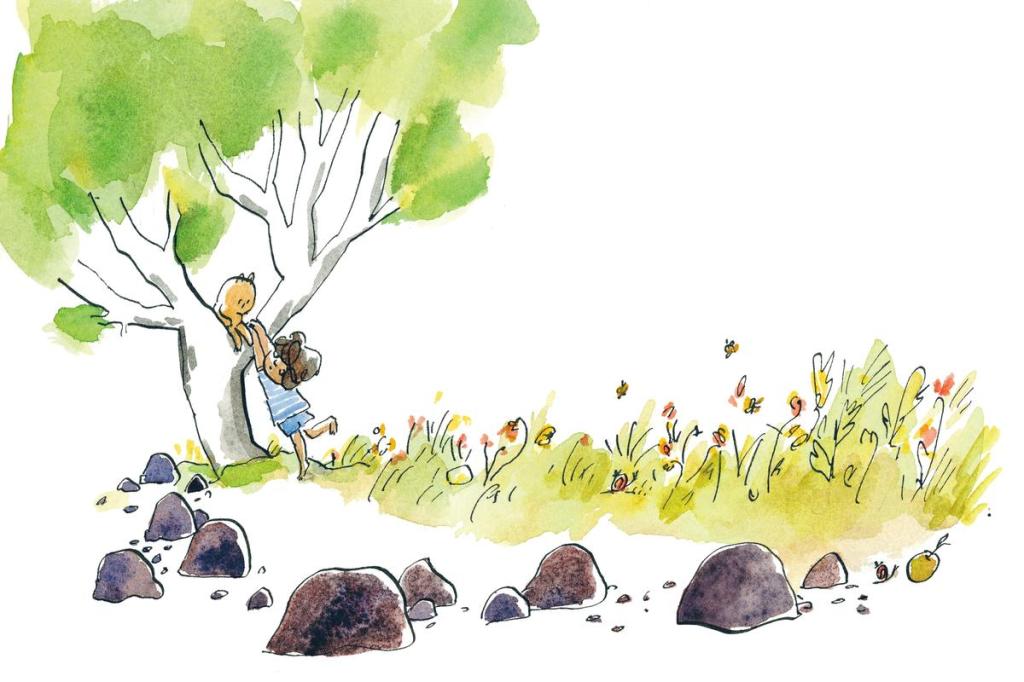

This study examines how Into the Uncut Grass (Noah, 2024) reconfigures child agency through a relational ontology informed by New Materialism. Drawing on Spyrou’s (2018) framework of relational agency, it analyses three assemblages (a network of relations) through which the protagonist’s agency emerges via intra-actions among human and nonhuman entities. Ultimately, the study challenges idealised, autonomous conceptions of childhood, revealing agency as affective, negotiated, and co-constituted.
The emergence of child agency as a conceptual concern can be traced to the twentieth century, when scholars began to pay critical attention to childhood and children (Beeck, 2020). Before the 1960s, such attention was limited. Heywood (2018) notes that only adults were considered fully human, while children were viewed as ‘becomings’—incomplete beings awaiting full personhood. The global children’s rights movements of the later twentieth century, alongside the rise of scholarship on the new sociology of childhood, transformed this perception and fostered a widespread recognition of children as active social participants capable of influencing their worlds. By the early twenty-first century, the idea of the child as agentic had achieved widespread acceptance (James, 2009; Heywood, 2018).
Yet, even within this progress, the discourse around agency remained largely anthropocentric and individualistic. Early models privileged the autonomous, rational child subject, overlooking the web of material and affective forces that shape children’s actions. Spyrou (2018) argues that such models risk reproducing liberal humanist assumptions that position children’s agency as self-contained rather than relationally constituted. In response, new materialist and posthumanist theories, through concepts such as intra-action (Barad, 2007)—the view that entities do not pre-exist their encounters—and assemblage (Deleuze & Guattari, 1987; Latour, 2005)—the constellation of heterogeneous elements (human and material) whose temporary alignments generate capacities to act, have shifted focus from isolated subjects to networks of relations. Agency, in this framing, is emergent, distributed, and co-constituted across human and nonhuman entities.
This essay situates Trevor Noah’s Into the Uncut Grass (2024) within that theoretical landscape, exploring how the picturebook reconfigures child agency through a relational ontology. Drawing on Spyrou’s (2018) framework of relational agency, which understands agency as the outcome of ongoing negotiations and interdependencies among entities, this essay conducts a multimodal reading attentive to both verbal and visual meanings. This follows Christensen’s (2017, p. 362) argument that visual representations of childhood also “suggest certain ideas of education.” Through this lens, the essay analyses three key assemblages—the assemblage of chores, the assemblage of the mystic, and the assemblage of the boy–Walter–mother dynamic—through which the protagonist’s agency emerges. These assemblages illustrate how the child’s encounters with objects, creatures, and affective atmospheres shape his decisions and self-understanding, ultimately challenging idealised notions of childhood as inherently autonomous.
The Assemblage of Chores
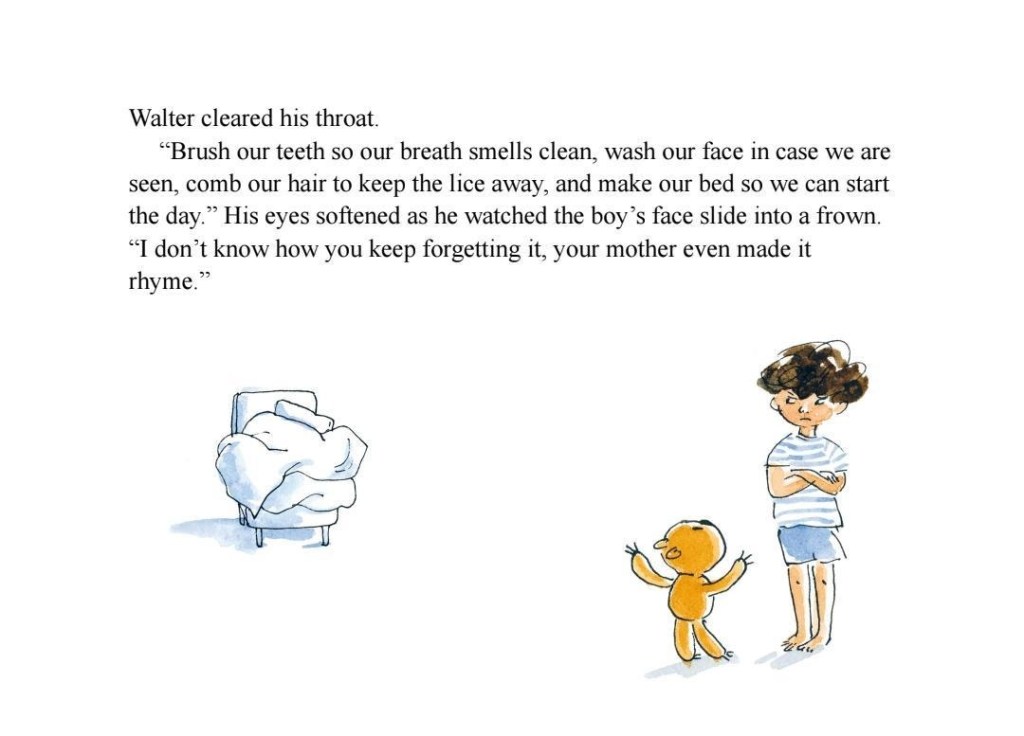
Into The Uncut Grass opens with an introduction to the protagonist, ‘the boy’ and his teddy bear, Walter. It is a Saturday morning, and the boy is excited to go outside to play. However, Walter, his bear, reminds him that before that, they must complete their morning routine set by his mother: “Brush our teeth… wash our face… comb our hair… and make our bed” (p. 22). In Figure 1, you see the boy’s anger towards the unmade bed, symbolising the chores he considers constraints on his agentic will. Thus, these activities already demonstrate agency in their capacity to act on the boy and elicit a reaction (anger), as new materialists describe it, an ‘affect’ (Spyrou, 2018).
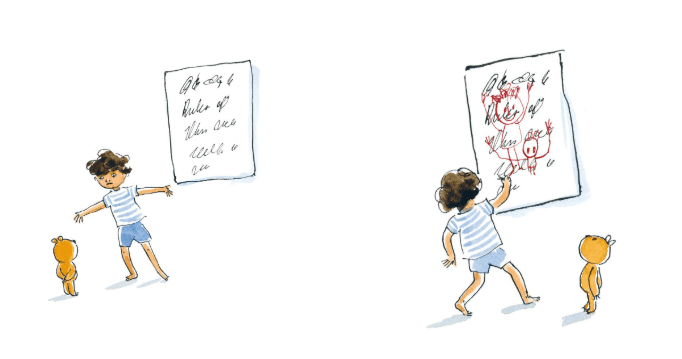
The subsequent sequence of images visualises the boy’s negotiation with this assemblage. In Figure 2, he and Walter are before a poster outlining the routine, and the boy questions its logic: “the bed doesn’t want to be made. That’s why it keeps unmaking itself” (p. 27), he laments. By playfully attributing will to the bed, he redistributes agency to the nonhuman. In the next image, the boy decides to draw over this list, symbolising his attempt to override its hold on him. This culminates in his declaration, “Today, we will run away” (p. 29), a rebelling act that marks his first ‘thick’ agentic decision in Spyrou’s (2018) terms.
Barad (2007) argues that agency manifests when multiple entities intra-act. Similarly, the boy’s agency here is not self-contained. His initial excitement stems from weekend playtime, but the chores—through their intra-action—become triggers for his rebellion. Running away thus becomes an instance of new materialist agency: affective, negotiated, and materially mediated.
The Assemblage of the Mystic
The mystical realm of the Uncut Grass also plays a central role in negotiating the boy’s agency. Once the boy enters this realm, he encounters various creatures, each contributing affective inflexions that reshape his understanding.
Firstly, he meets the Garden Gnome, who interrogates his mission in the realm and invites him to reflect on his protest against his mother — “Every person is just an obstacle unless you try to understand them. Even your mother!” (p. 47) the gnome advises the boy. Their brief meeting generates an affective shift, prompting the boy to reflect: “I wonder if things would be different if our mother understood” (p. 51). His thought signals the emergence of reflexivity as a relational event. In this context, an outcome of the affective entanglement between the boy, the creature, and the environment.
From the gnome, the boy meets two snails arguing about an apple. Their resolve to embrace their differing opinions generates another affect on the boy, who realises that he has never afforded his mother the same consideration. He turns to Walter and asks, “What do you think we would have seen if we tried things Mom’s way?” (p. 71). This suggests a growing recognition that agency may also involve yielding, echoing Lee’s (2001) argument that dependence can be an expression of agency.
In his final encounter in the Uncut Grass, the boy meets a group of Coins partying. They were celebrating the resolution of a conflict about ice cream and parties, which was fixed by flipping one of their own and accepting the outcome. This led to yet another dawning on the boy who can not reconcile wanting his way with compromising to follow another’s.
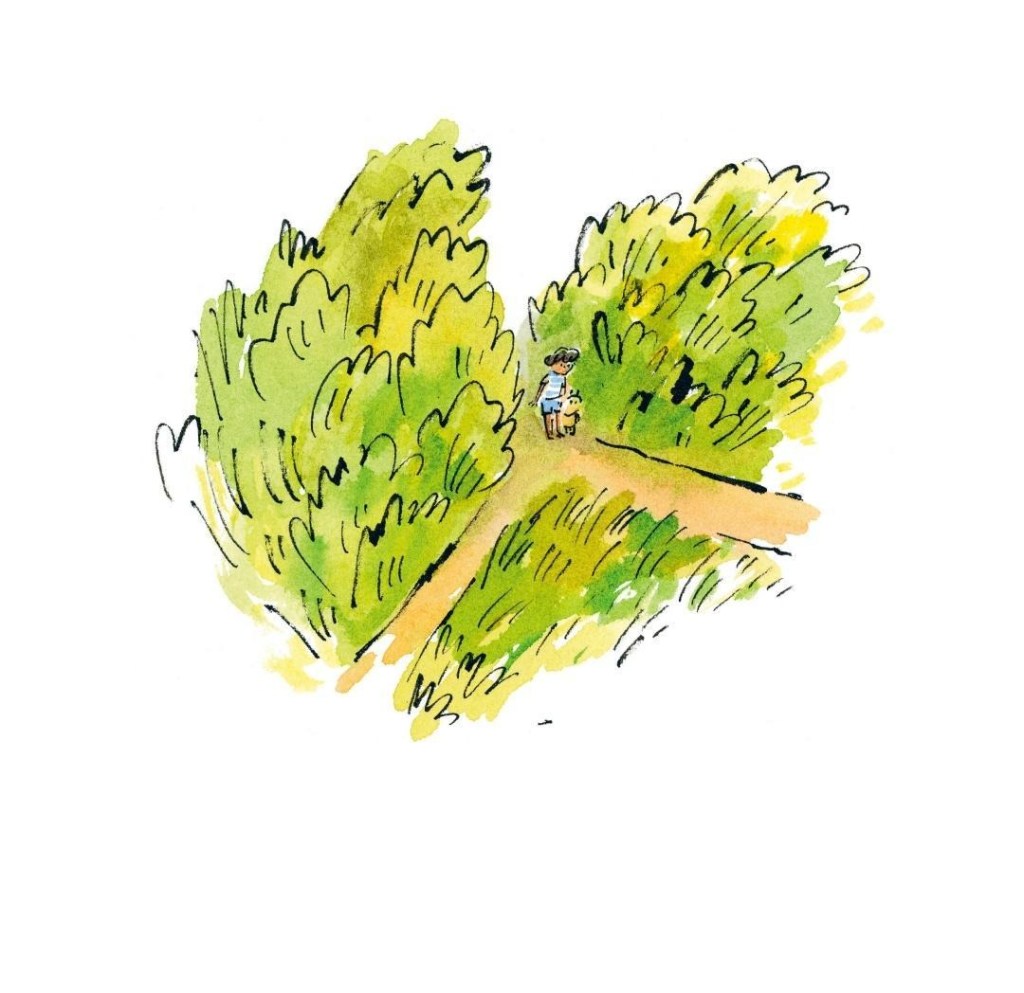
These encounters eventually leave the boy at a crossroads, literally as seen in Figure 3 and metaphorically. He is torn between taking the path that leads deeper into the Uncut Grass or the path leading back to his mother. In the end, he decides to flip himself like the Coins, and when he lands on his back, he cheerfully announces to Walter, “I think I know what we should do now” (p. 92), exercising the relationally developed agency to give up his quest and go back to his mother.
The Assemblage of the Boy, Walter and the Absent-but-Present Mother
The relational dynamic among the boy, Walter, and the mother complicates individualistic conceptions of agency even further. Throughout the story, while the reader never sees or hears directly from the mother, her presence is deeply felt. She is voiced through Walter, remembered through nostalgia, and echoed by entities in the Uncut Grass.
The first time the mother is alluded to in the narrative, it is heard through the bear, Walter, who reminds the boy of the chores: “I don’t know how you keep forgetting it, your mother even made it rhyme” (p. 23). As seen in Figure 1, the mother is visually absent, yet the affective force of her authority is visible in the boy’s frustration. When the boy retorts, “Who says she knows best?” Walter replies, “She’s gotten us this far” (p. 24), again mediating her voice and care.
Each time the boy attempts to assert his independence, the mother’s “ghostly presence” re-emerges. Upon his declaration to run away, Walter invokes her again: “Your mother will miss you. And where will we sleep? And who will make us waffles?” Her care, expressed through waffles, counterbalances his desire for independence, shaping his emotional and moral reasoning.
When Walter is not mediating the mother’s agency, she is there in his lone ruminations and nostalgia. At the gate of the Uncut Grass, he hesitates, recalling her previous warnings; he also thinks of her freshly made waffles whose aroma must have already filled the kitchen; and her soft humming that usually accompanies the smell room to room until they both hit his senses. These memories momentarily pull him back toward home, as seen in Figures 4 and 5. They function as nonhuman agents in their own right, shaping his emotional landscape, and in the process, creating a momentary pause in his rebellion. Yet he transforms this longing into determination: “We’re on our own now” (p. 39), he says to the bear, as he pushes the gate open.
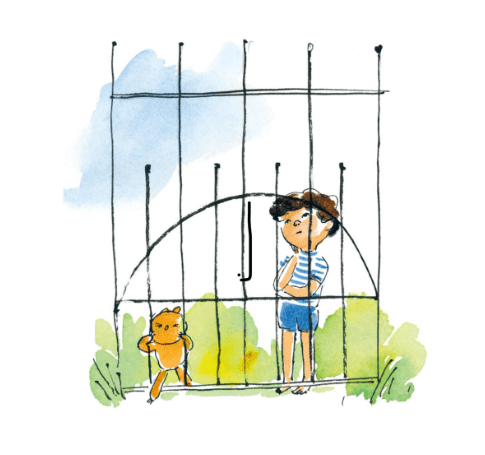
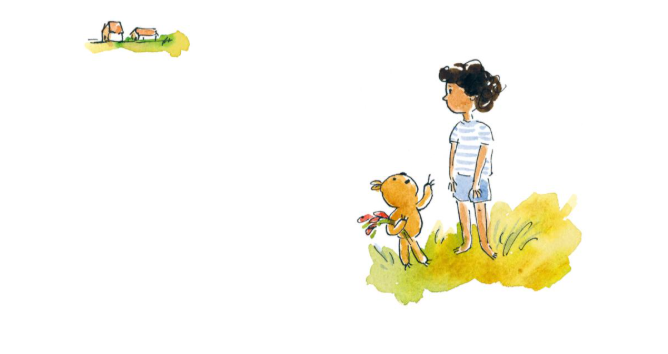
Even within the fantastical realm, the mother’s essence reverberates. Each of the creatures he encounters repeats variations of her lessons and caution, suggesting that she is distributed across the landscape of his imagination. When he ultimately flips himself “like a coin” and decides to return home, the decision is an enactment of relational agency, shaped by the accumulated intra-actions among Walter, the mother’s diffused presence, and the creatures of the Uncut Grass.
This assemblage thus complicates the idealised image of the autonomous child, revealing agency, as Syprou (2018) argues, as an emergent property of entangled relations rather than individual will.
Rethinking Child Agency
The boy’s journey—from dependence to imagined autonomy and back to chosen dependence—illustrates the central claim of relational ontologies: that agency is an emergent effect of interdependencies (Barad, 2007). It also reflects Lee’s (2001) and Correy and Farrugia’s (2014) arguments that choosing dependence can itself be agentic. As Correy and Farrugia warn, “equating agency with resistance to existing structures may result in a position where those identities or actions that are not seen as emancipatory become labelled as non-agentic” (In Spyrou 2018, p. 127). Into the Uncut Grass counters such assumptions by portraying agency as participation within a web of relation rather than freedom from adult influence.
The narrative’s status as an imaginative construction further destabilises the fantasy of the autonomous child-agent. Walter, a supposedly inanimate teddy bear, gains life through the boy’s imagination; the mystical realm and its creatures emerge from the boy’s affective world; and the mother’s instructions reverberate through both Walter and the fantastical encounters. This interplay reframes agency as relationally scaffolded even within a child’s private imaginative space.
Ultimately, Into the Uncut Grass invites readers to reconsider what it means for a child to act. By portraying agency as a web of entanglements rather than a property of an isolated individual, Noah’s story contributes to a decolonial and posthumanist reimagining of childhood—one attuned to the vibrancy of matter, the ethics of interdependence, the transformative power of relation, and the need for more just and inclusive representations of children’s lived realities.
Bibliography
Primary sources
- Noah, T. (2024). Into the uncut grass. (Hahn, S., Illus.) One World.
Secondary Sources
- Barad, K. (2007). Meeting the universe halfway: Quantum physics and the entanglement of matter and meaning. Duke University Press.
- Beeck, N. (2020). “Introduction”. In Nathalie op de Beeck (ed.): Literary Cultures and Twenty-First Century Childhoods. Springer International Publishing, pp. 1-22.
- Christensen, N. (2017). “Picturebooks and representations of childhood” In Bettina Kümmerling-Meibauer (ed.) The Routledge Companion to Picturebooks, pp. 360-370.
- Deleuze, G. and Guattari, F. (1987). A thousand plateaus: Capitalism and schizophrenia. Translated by Massumi, B. Minneapolis: University of Minnesota Press.
- Heywood, C. (2018). “Introduction”. In Collin Heywood: History of Childhood. 2nd. Ed. London: Polity, pp. 1-8.
- James, A. (2009). ‘Agency’, in Jens Qvortrup et al (eds.): The Palgrave Handbook of Childhood Studies. Palgrave, p. 34-45.
- Latour, B. (2005). Reassembling the social: An introduction to actor-network-theory. Oxford: Oxford University Press.
- Lee, N. (2001). Childhood and society: Growing up in an age of uncertainty. Buckingham and Philadelphia: Open University Press.
- Spyrou, S. (2018). ‘What kind of agency for children?’, in Disclosing Childhood. Basingstoke: Palgrave Macmillan, pp. 117-156.
 SLIDING MAGAZINE
Leave a comment