
How does the action comic series I Kill Giants fit into horror? This book review touches upon the use of fantasy as an escape from reality, and how fear does not need to come from the supernaturals for dread to settle in one’s stomach.
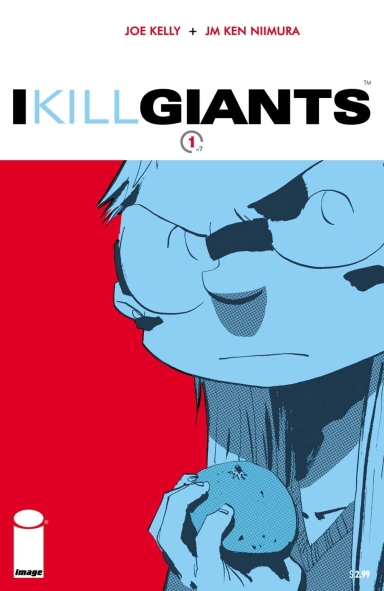
I Kill Giants is a graphic novel by Joe Kelly and artist J. M. Ken Niimura, first published in 2008, and turned into a film in 2017. Our protagonist, Barbara Thorson, is a young girl who claims to kill giants for a living during her free time outside of school.
That was all the information I had before I started reading this comic novel. I found I Kill Giants on the shelves of my local library, drawn to it by the name and the cover art with eye-catching blue and red highlights (later I would know that this cover is the one of the 15th anniversary’s edition). I was curious because, more often than not, I am irritated by the portrayals of preteen girls in media created by men. In my experiences, more often than not, men portray young girls in a lackluster manner, not necessarily bad or outright misogynistic way, more so, the characters don’t feel fleshed out, and the mobilising topics for the narrative can be limited to what are stereotypically perceived as ‘girl/female issues’, failing to build a character that feels genuine. Sometimes, you pick up something just because your prejudices being proven right can be somewhat comforting.
I am pleased to say I was proven wrong.
If you are someone whose reading experience is affected by spoilers, I’d suggest you read the comic beforehand. If not, I would hope I can persuade you to add it to your ‘To Be Read’ or TBR list.
Now, I will talk through some of the main plot points and explain some of my interpretations of this comic. As a book lover and, in this capacity as a writer, I also encourage you to engage with this article in a critical manner: Do you agree with what I have highlighted about the comic? Are other themes and ideas flying over my head? After all, our magazine hopes to open discussions and spaces where multiple opinions around media for and about young people are shared.
So, what is this comic about?
This late-2010s graphic novel has been widely acclaimed by multiple critics and the public (which is NOT the case for the movie. I am not too keen on watching it because of the comments I have encountered). Although it is starred by a pre-teen girl, a wide and diverse audience can empathise and recognise themselves in it.
Barbara is obsessed with fantasy, which serves as one of the reasons why she is ostracised at school. She sits at the ‘geek table’ during lunch, plays D&D (Dungeons and Dragons), and is overtly vocal in general, which is fuelled by defiance as well. This often gets her in trouble, making her well acquainted with the school principal, whose main threat to Barbara is to call home.
At its core, this comic is about a young girl who struggles to make friends and uses fantasy as an escape; however, her misfit status also causes her to be the target of bullies. She has become so obsessed with fantasy that she cannot stop talking about it. This causes even more difficulties in connecting with others. As we start seeing the world through Barbara’s eyes, it is possible to recognise how much her passion for fantasy has affected her perception of reality.
Where is the horror?
Although Barbara is scared of the catastrophe a giant could cause in her world, this imaginary scenario is her main distraction. Fantasy serves as a clear escape from an unpleasant reality. And although her school life might seem a bit difficult, her real monsters reside at home.
We slowly learn about Barbara’s relationship with her sister, and how home seems like an intimidatingly dark and haunting place without her presence. The authors carefully thread the story and what is haunting Barbara in such a way that the reveal comes not necessarily as a surprise but is effortlessly tied into the action sequence and emotional peak of the story. Barbara can no longer hide and ignore the emotional buildup within her, and as much as she tries to focus on the giants causing a ruckus across town, the people in her life demand her attention as well. Escapism only lasts so long.
Although Barbara is submerged in this world of fantasy and magic, where we see her trying to perform enchantments and talk at length about the different threats that each type of giant represents, it is not enough. The haunting presence in her house cannot be ignored despite her best efforts. We see the visceral reaction in Barbara as she hears her name called from upstairs, the tension and fear it inspires within her.
For Barbara, her demons reside at home. However, this also raises some questions:
Are these ‘demons’ supernatural? And are the giants even real?
That, dear reader, is for you to discover and decipher. I highly encourage you to read this graphic novel because it not only tells a very compelling story, but the artistic style also holds great value, creating a brilliant relationship with the text and its metaphors.
 SLIDING MAGAZINE
Leave a comment