
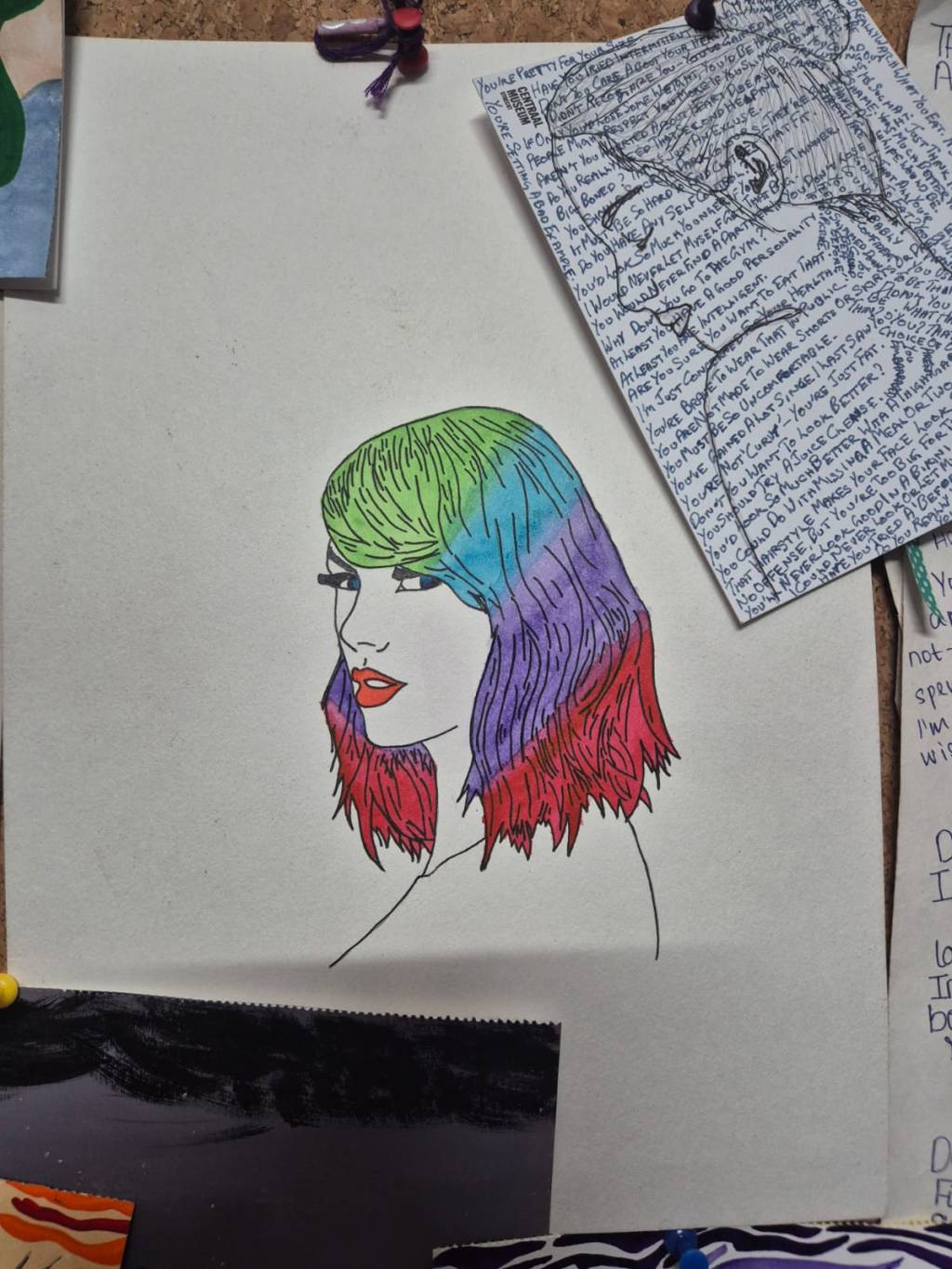

Taylor Swift’s songwriting is not merely emotional storytelling — it is literary reclamation in microcosm. Across her twelve-album catalogue, she revives and reinterprets figures like Ophelia and fairytale princesses, layering her intimate emotional voice with motifs from mythology, Gothic fiction, and Romantic poetry. This article analyses how Swift uses literary reference (in The Fate of Ophelia and beyond), how she renders everyday emotions in lyrical economy, and how her work echoes the silenced women in Jane Eyre and Wide Sargasso Sea. In doing so, we see how Swift becomes a modern poetic interpreter — the English teacher of her audience, whose songs invite readers to revisit literary tradition through melody, lyrics, and visual storytelling.
I never expected a pop chorus to send someone back to Hamlet, but that’s exactly what happened: my sister, who had never cared much for Shakespeare, came to me asking, “Who is Ophelia?” because of a song.

©Wikimedia Commons
That’s the kind of literary doorway Taylor Swift opens through sound. In the opening track The Fate of Ophelia of her twelfth studio album The Life of a Showgirl, Swift invokes Shakespeare’s tragic, water-borne figure. She does not simply recount Ophelia’s despair, but reframes her as a presence whose story can be reclaimed and reimagined. Rather than letting Ophelia dissolve into madness, Swift situates her within emotional ruin and possible rescue, singing of someone who “might’ve drowned in the melancholy” but was saved. This inversion of fate mirrors a larger pattern in Swift’s work: reviving literary figures in contemporary emotional terrain. Her music becomes an act of storytelling across mediums, creating multi-layered resonance.



During her April 2025 appearance on The Tonight Show Starring Jimmy Fallon, Taylor Swift described her creative process for The Life of a Showgirl as a deliberate play with “different tones — almost like different time periods of the way people used to speak.” She noted that she was fascinated by what she called “Shakespearean ways of speaking and terminology,” explaining how she layered archaic phrasing into contemporary lines to evoke emotional time travel. Swift even cited her own lyric — “’Tis locked inside my memory / And only you possess the key” — as an example of this Elizabethan diction set within a modern context. Moments later, she pointed to the line “Pledge allegiance to your hands / Your team, your vibes” to show how she blends past and present registers, juxtaposing medieval devotion with Gen Z colloquialism.
This self-awareness reveals the linguistic intelligence at the heart of her songwriting. Swift isn’t merely referencing the past; she’s orchestrating a conversation between centuries. By mixing Shakespearean rhythm with twenty-first-century idiom, she builds songs that feel timeless yet distinctly contemporary. The Life of a Showgirl thrives on this friction — where ‘tis meets vibes, and the tension between poetic grandeur and conversational ease produces a language that is uniquely hers.
Beyond Shakespearean echoes, The Fate of Ophelia also weaves in what fans interpret as Disney-inspired character references, blending narrative lyricism with pop-cultural imagery. Taylor Swift (2025) sings:
“All that time / I sat alone in my tower.”
Here, “time” evokes the Beast (Beauty and the Beast), while “tower” signals Rapunzel (Tangled), reflecting periods of isolation and introspection.
“You were just honing your powers / Now I can see it all (I can see it all).”
The lines align with Elsa (Frozen) mastering her abilities, and Anna and Olaf (also Frozen) experiencing revelation and perspective.
“Late one night / You dug me out of my grave and / Saved my heart from the fate of Ophelia.”
Cinderella embodies “late one night,” Meg (Hercules) represents being “dug out of my grave,” Snow White symbolises “saved my heart,” and the phrase “fate of Ophelia” channels anxiety, fear, and bravery.
“Keep it one hundred / On the land, the sea, the sky / Pledge allegiance to your hands / Your team, your vibes / Don’t care where the hell you been / ‘Cause now you’re mine / It’s ’bout to be the sleepless night / You’ve been dreaming of / The fate of Ophelia.”
This sequence has been interpreted by fans as referencing Jiminy Cricket (“Keep it one hundred”), Prince Eric (“on the land”), Ariel (“the sea”), the seagull (“the sky”), Scar (“Pledge allegiance”), Yzma (“to your hands”), Kronk (“your team”), Kuzco (“your vibes”), Zeus (“Don’t care where the hell”), Pain (“you been”), Panic (“’Cause now”), Ursula’s human and octopus forms (“you’re mine” / “it’s ’bout to be”), Sleeping Beauty’s prince (“the sleepless night”), Maleficent (“you’ve been dreaming”), and Sleeping Beauty (“of”) (Mr. Thomas English, 2025).
Breaking the lyrics into smaller blocks allows for analysis without reproducing the full song, maintaining focus on Swift’s literary, cultural, and emotional references. Each snippet functions as a critical lens, showing how she maps—or is perceived by her listeners to map—Disney archetypes onto Ophelia’s narrative arc, blending classical literature, childhood mythology, and contemporary storytelling. Fans, too, play an active role in this interpretive process, creating and sharing intertextual readings of Swift’s work that mirror her own playful layering of meaning and symbolism (Mr. Thomas English, 2025).

Swift’s gift for literary translation extends into Carolina, the haunting single she wrote for the 2022 film Where the Crawdads Sing, adapted from Delia Owens’s novel. The song is steeped in Southern Gothic imagery — “You didn’t see me here / They never did see me here” — capturing the novel’s tone of isolation, nature, and the silencing of women. Its sparse instrumentation and whispered vocals mirror the Carolina marshland itself: still, mysterious, and echoing with hidden pain. Much like Kya from Owens’s narrative, Swift’s voice drifts between worlds — the seen and unseen, the accused and the innocent. The song functions as both a narrative complement and a lyrical ghost story, demonstrating her ability to enter the consciousness of another text and translate it into music. In this way, Carolina extends Swift’s literary world-building beyond her albums and into film, reinforcing her ongoing dialogue with literature and visual storytelling.
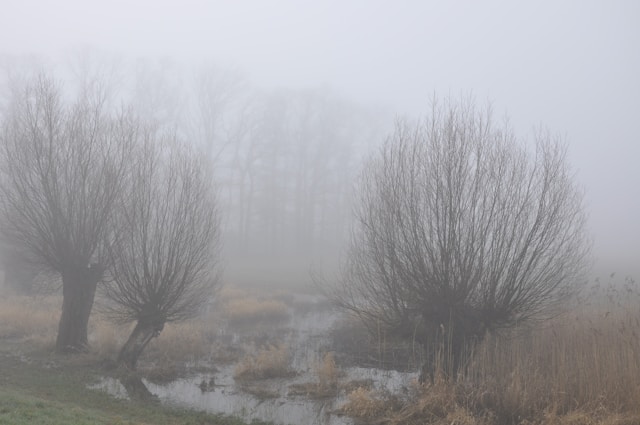
Swift’s literary nods extend beyond classic tragedies or Gothic texts. In Peter, the chorus — “You said you were gonna grow up / Then you were gonna come find me” — echoes Wendy’s dilemma in J. M. Barrie’s Peter Pan. Swift now revisits a theme she first explored in Cardigan (Folklore), where the lyric “Peter losing Wendy” functions as a direct intertextual link to this later song, underlining an ongoing narrative of separation, desire, and memory. Through these layered references, Swift reimagines beloved literary characters while channelling universal feelings of loss, nostalgia, and yearning. The interplay between Peter and Cardigan exemplifies how her lyrics create dialogue across albums, blending literary homage with personal emotional storytelling.
Earlier explorations of loss and memory continue in Swift’s linguistic precision, where her lyricism often rests on a single, carefully chosen word. Take Peter (from The Tortured Poets Department), where she sings, “once found us beguiling.” That one word — beguiling — invites the listener to pause, reread, and annotate, demonstrating her precise command of language. In Opalite, she paints a nightscape: “Sleepless in the onyx night,” later layering it with “now the sky is opalite.” Fans have speculated that “onyx night” nods to Rebecca Yarros’s Fourth Wing / Onyx Storm series, though no confirmation has emerged, making it a speculative but fascinating thread in fan discourse.
Across her twelve albums — from Taylor Swift (2006), Fearless (2008), Speak Now (2010), Red (2012), 1989 (2014), Reputation (2017), Lover (2019), Folklore (2020), Evermore (2020), Midnights (2022), The Tortured Poets Department (2024), to The Life of a Showgirl (2025) — Swift consistently intertwines fairytale imagery, mythic archetypes, and emotional interiority. On Fearless, she juxtaposed Love Story (a reworking of Romeo and Juliet) with White Horse, which subverts the fairytale ideal: “I’m not a princess, this ain’t a fairy tale / Too late for you and your white horse.” Today Was a Fairy Tale similarly courts romantic wonder, yet with an awareness of fragility, signalling early experimentation with hope, disappointment, and narrative expectation.
But Swift’s skill lies not merely in imagery; it is in her economy of expression. When she sings, “Romeo, take me somewhere we can be alone,” she transforms Shakespeare into personal possibility. In The Lakes, she evokes Romantic isolation and creative refuge in a single line: “Take me to the Lakes where all the poets went to die,” calling upon Wordsworth and his contemporaries as shorthand for longing and poetic devotion. Ivy (Evermore) conjures love’s creeping entanglement: “My house of stone, your ivy grows.” All Too Well compresses betrayal and commitment: “You kept me like a secret, but I kept you like an oath,” while Clean elevates heartbreak to elemental intensity: “The drought was the very worst.” Across her catalogue, Swift consistently follows the trajectory of concrete image → subtle metaphor → emotional turn, allowing listeners immediate access to layered feelings.
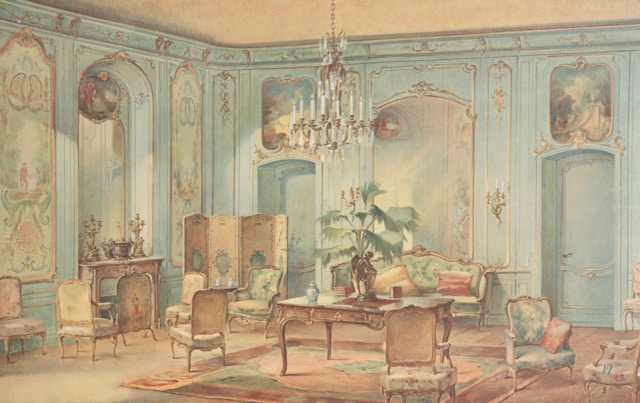
The literary breadth of Swift’s references is remarkable. In The Fate of Ophelia, she reanimates the silenced figure of Ophelia, reframing her narrative and granting her agency. This resonates with other literary women who have historically been marginalised. Swift’s critique of the silencing of women is also evident in Mad Woman (Folklore), where she sings, “Every time you call me crazy, I get more crazy.” This resonates with literary figures such as Bertha Mason, aka Antoinette Cosway, a woman whose voice was suppressed in Jane Eyre and Wide Sargasso Sea. Bertha Mason, confined in the attic in Jane Eyre, is silenced and demonised; Antoinette Cosway, Rhys’s reinterpretation in Wide Sargasso Sea, experiences cultural erasure and the stripping of her name and agency. Swift’s articulation of female suppression in Mad Woman mirrors these themes: “You made her like that” and “there’s nothing like a mad woman / what a shame she went mad” turn accusation into narrative reclamation, giving voice to women historically denied one. In effect, Swift’s music functions as a modern corrective to the silencing narratives of canonical literature, aligning her feminist critique with a broader literary lineage of resistance.
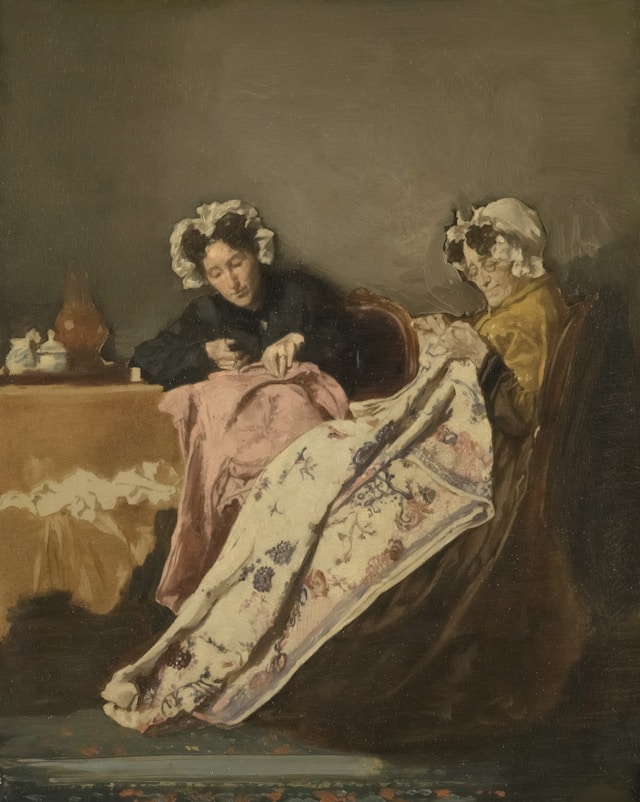
Swift’s visual artistry also deepens this literary resonance. For The Life of a Showgirl, she referenced Sir John Everett Millais’s iconic painting of Ophelia in album promotion and recreated the figure in the music video, dressing as Ophelia herself and performing amid Victorian-inspired imagery. The melding of lyrics, visual aesthetics, and costume creates a multidimensional interpretive experience, where literature, music, and visual art intersect. This visual homage, however, goes beyond mere aesthetic reference, transforming Millais’s static Ophelia into a living, multidimensional narrative.
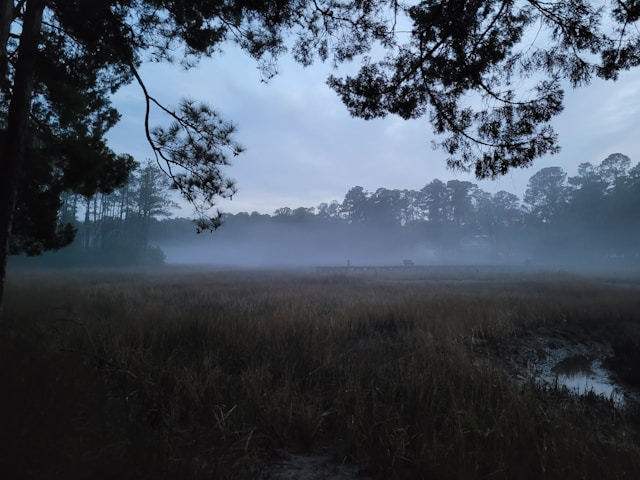
Taylor Swift’s homage to Millais’s Ophelia painting extends beyond mere reference; it is reimagined as a three-dimensional, immersive experience in The Fate of Ophelia music video. In Millais’s original, Ophelia floats in a river, framed in tragic, painterly stillness. Swift translates this two-dimensional image into a performative, living tableau: she dons a flowing, ethereal costume, positioning herself amidst water, foliage, and theatrical lighting to inhabit Ophelia’s world in real-time. This transformation has been described as “the breaking of the parallax,” where the image shifts from 2D to 3D, like stepping into a diorama (Artsy, 2025). The effect allows viewers to experience Ophelia’s narrative not as a static tragedy but as an interactive, multi-sensory story. The mise-en-scène, choreography, and costume together fuse visual art, music, and literary reference, reflecting Swift’s consistent blending of media to expand interpretive possibilities.
Songs like Peter and Opalite demonstrate Swift’s precise use of language. Single words, like “beguiling,” or expressions, like “onyx night,” create multi-layered resonance. Her lyricism invites listeners to interrogate meaning, revisit literature, and reflect on human emotion. Even speculative allusions, such as those connecting Opalite to Rebecca Yarros’s novels, illustrate the participatory culture Swift fosters: fans engage in interpretive scholarship, annotation, and intertextual exploration, treating lyrics as living texts.
Across her twelve-album canon, Swift demonstrates thematic and stylistic continuity. From Fearless’ romantic idealism and Gothic undertones to Folklore and Evermore’s literary sophistication, she crafts emotional architectures that reward close listening. All Too Well, Clean, Ivy, and The Lakes exemplify her ability to combine concrete imagery, subtle metaphor, and profound emotional resonance. In this way, Swift transforms personal experience into shared literary and emotional terrain.
The Life of a Showgirl’s twelve-track structure mirrors her meticulous composition. Opening with The Fate of Ophelia signals literary engagement, emotional reclamation, and thematic cohesion. The deliberate absence of surplus tracks ensures that each title carries weight, and the album’s imagery — nods to Millais’s painting, the Ophelia costume — merges visual and auditory storytelling. Across her catalogue, music videos, stagecraft, and artistic direction function as additional texts, inviting analysis alongside lyrics.
A defining feature of Swift’s creative universe is her constant interplay between past and present. Each album revisits earlier motifs — letters, mirrors, gardens, ghosts — not as repetition but as reflection. The Life of a Showgirl reworks earlier eras: the fairytale tone of Fearless becomes meta-theatrical; the heartbreaks of Red are reframed as performance. Swift seems acutely aware of how time reshapes emotion, much like a novelist re-reading her own chapters. Through this temporal dialogue, she positions memory as an art form: the past is not static but a stage that she re-enters, rewrites, and performs anew. Her fans, in turn, act as co-readers in this living archive, tracing symbols, decoding connections, and mapping emotional continuities across decades of work.


Swift’s literary homage extends into fairy tales and children’s stories, which she reinterprets through emotional realism. From rejecting the storybook rescue in White Horse to revisiting Peter Pan’s bittersweet nostalgia in Cardigan and Peter, she transforms familiar myths into meditations on agency, loss, and memory. The Fate of Ophelia furthers this by weaving parallels with Disney heroines — Ariel, Belle, and Cinderella — whose stories of constraint and rebirth mirror Ophelia’s reclaimed agency. Through these intertextual echoes, Swift bridges Shakespearean tragedy, fairytale archetypes, and pop mythology into one continuum of feminine self-discovery.
Ultimately, Swift’s oeuvre demonstrates how contemporary music can act as a conduit for literary engagement. Fans return to Shakespeare, Gothic fiction, Romantic poetry, postcolonial narratives, and even children’s literature because Swift’s songs invite them to inhabit emotional and literary spaces previously reserved for canonical texts. Her lyrics, imagery, instrumentation, and visual artistry create immersive interpretive worlds. Every word, visual reference, and instrumental nuance is meticulously crafted, revealing a depth of artistry that rewards curiosity and annotation.
Yet this article captures only a fraction of Taylor Swift’s genius. One could devote an entire book to dissecting her twelve albums — the literary allusions, metaphorical precision, vocal and instrumental interplay, visual storytelling, music videos, stagecraft, and banding choices. It is this intricate, multidisciplinary artistry that has inspired Ivy League courses on Taylor Swift, cementing her status not just as a pop icon but as a legitimate subject of literary, musical, and cultural scholarship.
Bibliography
Music / Lyrics
- Swift, T. (2008). Love Story. On Fearless [Album]. Big Machine Records.
- Swift, T. (2008). White Horse. On Fearless [Album]. Big Machine Records.
- Swift, T. (2010). Today Was a Fairy Tale. On Speak Now [Album]. Big Machine Records.
- Swift, T. (2012). All Too Well. On Red [Album]. Big Machine Records.
- Swift, T. (2014). Clean. On 1989 [Album]. Big Machine Records.
- Swift, T. (2020). Mad Woman. On Folklore [Album]. Republic Records.
- Swift, T. (2020). Cardigan. On Folklore [Album]. Republic Records.
- Swift, T. (2020). The Lakes. On Folklore [Album]. Republic Records.
- Swift, T. (2020). Ivy. On Evermore [Album]. Republic Records.
- Swift, T. (2024). Peter. On The Tortured Poets Department [Album]. Republic Records.
- Swift, T. (2025). Opalite. On The Life of a Showgirl [Album]. Republic Records.Swift, T. (2025, October 7). Interview with Jimmy Fallon [Television broadcast]. The Tonight Show Starring Jimmy Fallon. NBC Universal
Literature
- Barrie, J. M. (1911/2005). Peter Pan. New York, NY: Penguin Classics.
- Brontë, C. (1847/2003). Jane Eyre. London, UK: Penguin Classics.
- Rhys, J. (1966/2000). Wide Sargasso Sea. London, UK: Penguin Classics.
- Shakespeare, W. (1603/1996). Hamlet (G. J. Wilson, Ed.). Oxford, UK: Oxford University Press.
Art
- Millais, J. E. (1852). Ophelia [Painting]. Tate Britain, London, UK. Public domain.
Online Sources
- Artsy. (2025). Taylor Swift channels Millais’s Ophelia in new album promotion. Retrieved from https://www.artsy.net/article/taylor-swift-ophelia
- Billboard. (2025). Taylor Swift ‘The Fate of Ophelia’ single and album details. Retrieved from https://www.billboard.com/music/music-news/taylor-swift-life-of-a-showgirl-release-date-track-list-1236043042
- Cosmopolitan. (2025). What we know about The Fate of Ophelia and its literary echoes. Retrieved from https://www.cosmopolitan.com/entertainment/celebs/a67967543/taylor-swift-the-fate-of-ophelia-music-video/
- Elle. (2025). Everything to know about Taylor Swift’s album The Life of a Showgirl. Retrieved from https://www.elle.com/culture/music/a65654090/taylor-swift-new-album-news-release/
- Mgladwriting. (n.d.). Taylor Swift — Fearless, fairytales, and Folklore. Retrieved from https://mgladwriting.medium.com/taylor-swift-fearless-fairytales-and-folklore-3dd88342e163
- StageRightSecrets. (n.d.). Taylor Swift – Mad Woman lyrics. Retrieved from https://www.stagerightsecrets.com/mad-woman-lyrics-taylor-swift/
- Taylor Swift Scholar. (2021). “I’m not mad I’m just disappointed”: Deconstructionist autocriticism in White Horse. Retrieved from https://www.taylorswiftscholar.com/post/i-m-not-mad-i-m-just-disappointed-deconstructionist-autocriticism-in-white-horse
- The Criterion. (n.d.). The retrieval of relegated identity of Bertha Mason in Jean Rhys’s Wide Sargasso Sea. Retrieved from https://www.the-criterion.com/the-retrieval-of-relegated-identity-of-bertha-mason-in-jean-rhys-wide-sargasso-sea/Mr. Thomas English. (2025, March 10). Taylor Swift – The Fate of Ophelia Disney character references [YouTube Short]. YouTube. https://www.youtube.com/@MrThomasEnglish
 SLIDING MAGAZINE
Leave a comment