

We’ve all heard in school about the importance of literacy. But what about reading for fun? Through this interview, Elaina Ryan reminds us about the importance of finding joy in books and sharing this enthusiasm with younger readers. Learn more about her insight and the fantastic initiatives that she is leading with Children’s Books Ireland!
Okay but – what will you do once you’re done with your degree?
While this question is enough to scare any university student, it is a special burden for those of us who have had the honour to spend the last years doing close analyses of Victorian children’s books. How do these skills and knowledge translate on the job market? And for which purposes should we put them to use?
Well, I decided to take matters into my own hands and to find answers at the source. Welcome to “Sliding into the DMs of book professionals”, the series in which I bother people in the field of children’s books and ask them about their own job, values and pathways.
Today, we meet Elaina Ryan, the CEO of Children’s Books Ireland, an organisation that I have admired for years and whose work is internationally praised across literacy circles. Now, literacy (i.e. the capacity to read and write) is at the heart of this conversation, since Children’s Books Ireland’s aim is to bring reading at the heart of every child’s life, not only for school but mostly for fun. Indeed, on top of contributing to the development of speech and language abilities as well as being crucial in terms of social mobility, literacy comes with a multiplicity of personal benefits for young readers, such as the development of imagination, creativity as well as empathy (Booktrust, n.d.). Interestingly enough, scholars and teachers seem to indicate that the best way to get children to read is to make them love to read in the first place (Worthy, 1996; Miller, 2009), and this is precisely the mission which this charity has taken on. Along with a team of experts, Elaina is working in the field of literacy promotion to ensure that gatekeepers of texts can access all the necessary resources to make reading enjoyable for young people across Ireland.
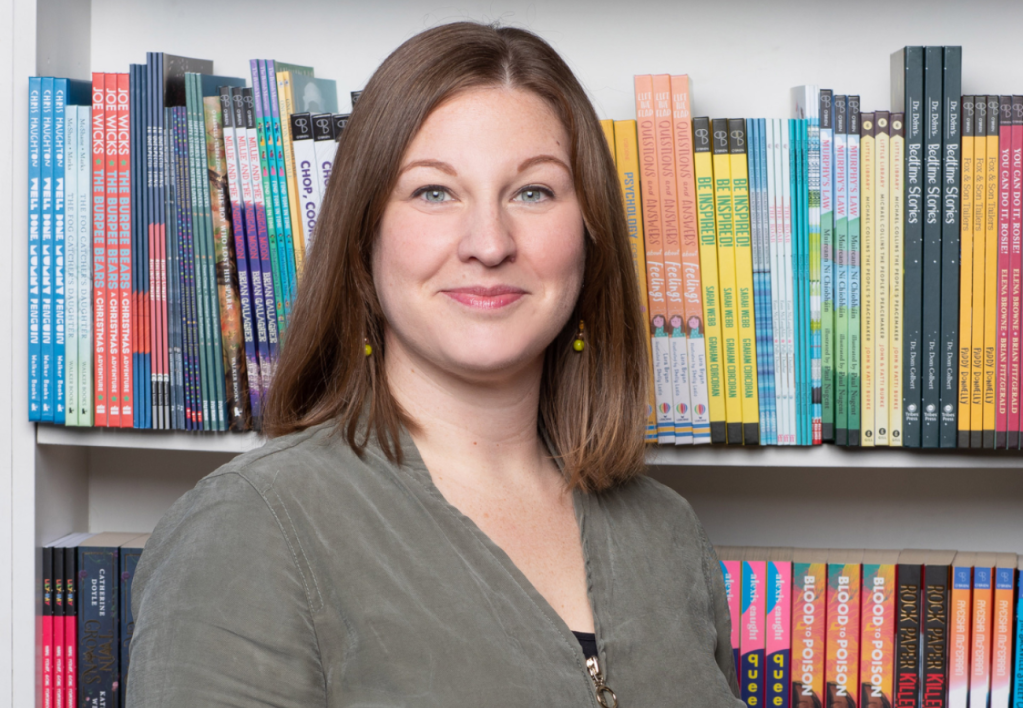
I had the great pleasure of interviewing Elaina Ryan back in January, at a moment which coincided with the last semester of my master’s degree. We were introduced by Daan Beeke, one of my internship supervisors at Stichting Lezen, an organisation which works to promote literacy for children and young people in the Netherlands. I already knew from this past experience that I would like to work in the field of literacy promotion, but listening to Elaina definitely opened my perspectives as to the amount of possibilities which exist to improve access to literature, and the positive impact which a single campaign could have across a country. Elaina’s energy and passion for the work that she is doing is truly infectious, and I hope that you’ll find as many answers in this conversation as I did.
Note to the reader: Due to personal convictions, this interview was transcribed entirely by hand, not using any AI tool. Some of the passages were cut for the discussion to fit an article format, and filler words were taken out by the editorial team for better fluidity.
Suzanne La Rocca (S.L.R.): So, you are the CEO of Children’s Book Ireland which has led incredible initiatives over the country. What does that mean in terms of the missions that you are doing? and what is your favourite part of the job?
Elaine Ryan (E.R.): Well, the role of Children’s Books Ireland is to champion every child’s right to develop a love for reading. From this vision, several missions arise.
Firstly, our goal is to inspire a love for reading in children and young people in Ireland. And that begins by giving them access to books in the first place. So we have a book gifting team who is in charge of handing books to schools, to charities, to children in hospitals etc. And we have a book gifting scheme for early years called Bookseed. We also organise the KPMG Children’s Books Ireland awards, which rewards excellence in books for young people, and this includes a Junior Juries’ Programme.
Second, we seek to share our expertise with gatekeepers, the adults who play a role in guiding what the children are reading. This is done partly through the creation of thematic reading guides available on our website, which aims to provide teachers, librarians, booksellers and publishers with recommendations of diverse, great-quality books on different topics. We also work together with a team of book reviewers on a magazine called Inis, to inform parents and gatekeepers about the current production of children’s literature. On our website, we also share links to resources, whether they are for parents and guardians or for schools and libraries, so you’ll find some of our initiatives there as well.
And then finally, supporting the artists! So we do a lot of formal hands-on training but also things like creating space for residences, get together for social networks like custom mornings to discuss issues that are important to them and mentoring them to do literature (like events on how to reach your audience etc). So it is quite a wide variety of things, and we work with different partners in different ways depending on what it is we’re trying to achieve.
S.L.R.: Yeah, it seems like you’re doing a lot!
E.R.: (laughs) Yes, we are!
S.L.R.: From what I’ve understood from my internship in the Netherlands, it’s at least the work of three to four organisations that you are doing.
E.R.: Yeah, we hear this a lot. But I think it was really interesting during our most recent strategic plan because it gave us an opportunity to assess our work really objectively and try to see that it all continues to be relevant. So we’ve retained our same vision which is “Every child a reader” and kind of working through a theory of change process, a logic model, to see: “We want every child to be a reader. What are the ideal conditions for that? What needs to happen?” So you know, number one is remove the barriers and make sure that kids can actually get a book in their hands. Number two, you need informed grown-ups, whether those are families or teachers, enthusiastic people who are motivated to support the kids in their lives. And number three is we need a pipeline of great writers and illustrators who are producing work, on a national level, of an Irish flavour, regardless of where they might be from originally. Whether they’ve been here a week or ten years, the literature that comes out of Ireland from all kinds of folks is important for Irish kids. So those are the three buckets I guess. Everything that we do has to fit in there but also we have to do all of those things! (…) You know, it’s a multi prompt approach, if you want a child to be a reader that’s what we believe are ways to go about it.
S.L.R.: So then, it is this powerful vision which helps to keep your work focused on that end goal, right ?
E.R.: Yes, we’ve developed that at the last strategic plan in 2020, and it was really useful for us to have that overarching vision to hang everything off, that we always come back to. (…) It helps us to remain focused and to remind ourselves that “well, this sounds like a really great idea, but actually children are going to be reading more at the end of it?”. Because sometimes, schools will do projects around World Book day, and have children dress up like their favourite characters and we don’t know at the end of it, if any of them read a book that day, so what’s the point? So you know, it helps us to be really focused when we take up a new idea: is it actually going to help us get closer to that vision where every child is an enthusiastic, motivated, well-supported reader?
S.L.R.: I see… And so to achieve that vision, what are your own departments? Do you also rely on external organisations? Would you collaborate with some universities for research purposes? How does it work?
E.R.: Yes. So in terms of departments, well, we laugh a bit because our teams are mostly individual people or two people (…). But effectively we have authority of people like publishing officer, manager, administrator, finance, and regarding the organisation we have a book gifting team and their job is to give away books so they work on all our school projects, children in hospitals and children in homeless services or asylum seekers. We have a communication team, with our communication manager who looks after our social media and social media officer who works with her. We have two fundraisers who work on a job share basis and then there‘s additional people within the organisation who are specialised: a part time Irish language officer who’s making sure that Gaeilge is included in every part of our organisation, a program and events manager who looks after things like organising our conference, our book giftings, our awards. We have a publication officer whose job is accepting and seeking all the books from all of the publishers who publish in the Irish market, whether they are in Ireland or in the UK. She is the person who does all of our publications. And then for the leadership, there is a CEO and deputy CEO. So we’re a team of 16 now in total. When I started here in 2013, they were 3 full-timers and 1 part-timer, so we’ve grown quite a lot over the years! It matches our ambition to do more and to do different things. We also have a part-time research and evaluation officer, so that we can measure the impact of what we’re doing, keep an eye on international research in the field (so the EU Read Network is brilliant for that, because there’s now a research network, it’s all connected). This way we can also measure the impact of the work that we’re doing and implement that learning as well as communicate it to ourselves and coordinators. It’s a small and busy team but it works.
And then, in terms of external bodies, we work on a network basis with third-level organisations, and with universities if there’s a particular project that we want to work with. We also have an ongoing relationship with Dublin City University. They hold the Children’s Book Ireland collection in their library. One copy of everything sits in special collections and the other is accessible in their main library so that training teachers can use it. That’s two copies from pretty much everything Irish authors and illustrators have published the last long while. We did have them in our office but an architect warned us that the weight was getting dangerous (laughs), so we had to clear it out but as you can see we get quite a lot of submissions that we hold on to for future publications, and others that we give away for donations. We also work together with various media partners to get the message out. We collaborate with a national paper called the Irish Contaminer. Every month, our publication officer writes an article for them so that there is a round up of brilliant books that have been recently published. That means that ongoing coverage for children’s literature and culture is available in national media and that is very important for parity esteem between adult and children’s literature.
S.L.R.: On your website, you also offer a variety of thematic reading guides, some of which are mostly in Irish. Of course, promoting reading in a bilingual country must come with a dual purpose: how do you deal with that ?
E.R.: Yes of course. So we found that there are a lot of children in Ireland who can read in Irish, but Irish is not, in most places in the country, a language that most people speak fluently. So, I’m responsible for hiring anyone who comes into the organisation. And we always, no matter the role, ask people if they speak Irish, because it’s definitely a skill to have and you get extra points if you happen to have a good level of Irish. Almost everyone will say: “Oh, I’d love to be better at it, maybe I’ll go back to class. I would be really willing to learn but actually I’m not very confident, especially to speak it”. And that’s the vast majority of people in Ireland. Most parents and young families have a desire to pass it on to their children but they’re not very confident in their own ability to communicate in Irish. With that in mind, we wanted to produce a guide that would cater for people who are raising their children comfortably through Irish, speak Irish at home, but would also have a line in English to be more accessible for booksellers and librarians who are not from Ireland, as well as those Irish folks who either didn’t have a good experience with Irish or don’t have a good grasp of the language. A lot of people are worried when we talk about books in the Irish language: and again it’s about parity of esteem and equality, that’s enraging for people who have Irish as their first language that everyone sees it as (…) dull and boring and not very vibrant… Because that’s not the truth of Irish language publishing: we have extraordinary picturebooks especially, and picturebooks are often the entry point that people feel safe in. They think “I can manage that level of language to read it to my child, so maybe I’ll get there”. So this guide was to serve an audience that probably doesn’t get enough attention, those who have great Irish and also to bring people in with the message of “Just try it, give it a go, it’s not that daunting, and look what’s in there”. It’s a really nice support for the Irish language industry, which, as you can imagine, is so, so tiny.
S.L.R: So I’ve heard. What about your Laureate na nÓg? Do they have a role to play in the promotion of the Irish language?
E.R.: Yes, we have a children’s laureate, and they are writers or illustrators at a very high level. But as well as getting an award of excellence for their body of work, they get to do a project, and we support them in that. Our current laureate is Patricia Forde, but our last laureate was Áine Ní Ghlinn and she wrote exclusively in Irish. So it was a real statement to have our first exclusively Irish language writing lines. And one of her programs was called An Bosca Leabharlainne which means The Library Box: as part of that, over two and half thousand boxes of 25 books in Irish were sent to schools all over the country.
And what was really interesting was that we were able to bring in our expertise when it came to selecting really good books. The problem of accessing books in Irish wasn’t just the fact that people didn’t have the money to buy them in schools (although that is also a problem), it was that they didn’t know where to look. So when we gave them a collection to put it in view of the children, it was really impactful. Because people were like “Well that’s a book about aliens, cool, I’m gonna read it”. (…) And the books weren’t strictly about Irish and how reading it could be fun: on the contrary, they weren’t too academic or didactic.
But the surprising thing for us was the level of convincing that teachers also felt they needed. If you’re hearing from primary school teachers that it really helped them feel more comfortable teaching Irish in a way that was a bit lighter and more fun than how they usually do it, then you know you have a problem in the education system (laughter) (…) But there are a lot of other initiatives around the country that are making Irish, especially spoken Irish, more accessible to more people. In Gaeltacht areas, areas where people speak Irish as a first language, you have what’s called PopUp Gaeltacht in pubs for instance, where people can come along and speak Irish regardless of their language level. And that’s bringing it much more into modern, everyday mainstream culture in a way that I think will actually have a huge impact: people will use the few words that they have and not be so afraid or daunted by the possibility that they might make a mistake (…).
S.L.R.: Yes, that’s such a great project and it’s fantastic to hear that there is an Irish revival once more. You mentioned the problem of having teachers not really being aware of the impact that they could have over their students, by sharing their enthusiasm about books, and then I’m wondering what kind of challenges would you say are proper to Ireland when it comes to reading promotion ?
E.R.: That’s a really good question. In fact, it’s really interesting, we’ve had a lot of interest, particularly from the Netherlands and after the TIMSS PIRLS results came out, you know Ireland is among the group of high performers and there’s all the caveat about how and when things were better, but regardless, there’s no denying that we’re doing okay in terms of how children can do those tests. But that doesn’t mean they love it.
I think what’s interesting is that there’s a global perception that Ireland is a leader when it comes to reading and reading promotion. But our experience in terms of hearing from schools is that reading promotion in a joyful way is still so badly needed. There are so many children who either aren’t reading for fun or who can’t engage at the level that TIMSS and PIRLS are showing the majority of children engaging and that seems very socio-economically divided.
So, as I said, we have a book gifting team and we give away to libraries in schools every year, to large and small degrees (…) But last year we had 757 applications for that program (…) it’s a huge demand, there is no money that comes from the government at the moment for school libraries in Ireland. They cut it in 2008 completely for the recession and since then they made one investment of 20.000.000€ which basically came down to 21€ per child. Without sustainable funding, there’s no way for schools to plan and to respond to the children who are in front of them, to buy dyslexia-friendly books or to replace books when they get worn out. So I think we’re seen as having an extraordinary set up and an extraordinary system and the government are very happy to lean on that message, whereas actually our experience in the schools is that you walk in, and books are sixteen years old and they’re falling apart, or they’ve been donated by families so they’re all written by David Williams or they’re replicates (you know the parents don’t have the information, they buy bestsellers in the shop, they read them, they donate them to the school, and it’s a vicious cycle). We feel that the reality on the ground, in schools, is that we still have a big job to do to bring the joy to reading, because it’s very hard to make reading joyful when you have a tattered library that doesn’t have the broad selection of genres for different abilities, different language levels, different preferences. You know, a kid is reading a series and they don’t have the budget to buy the next book in the series when it comes out, like… there are so many problems that still haven’t been solved because there is no sustainable investment coming from a central source.
So we’re still blocking a gap there as well as lobbying the government to show, firstly the positive impact of what we could do when we do have investors, but also the gaping problem that continues to exist because they’re not investing in a way that gives librarians (you know most schools don’t have librarians, but that gives teachers) the necessary resources.
S.L.R.: Yes. I understand that you have quite a great deal of agency, but at the same time, you cannot run the entire country on your own!
E.R.: Yeah (laughter), that’s the big thing. And I think the problem with not having funding for so long is that it develops a kind of scarcity mindset in schools, so that when we do give them books, sometimes they don’t let the children take them home for instance, in case they go missing(…). They haven’t had funding for so long, and now they have these precious books and they want to keep them and loaf them and for them never to go missing. Generally, we kind of see it as a success if a book goes missing: that’s great, it means a kid wants to take it home! (laughter). I can understand where schools are coming from too, but it’s a problem when the books aren’t having the intended impact because the teachers aren’t letting the children use them.
S.L.R.: That’s understandable! You mentioned the problem of not being able to purchase dyslexia friendly books. Now, I see that you have amazing book doctors at your book clinics who have been trained to deal with readers with special needs (such as dyslexia, autism, visual impairment). I wonder from your point of view and expertise, what do you think is the best way to get these children reading?
E.R.: The book clinics are brilliant because they are so individual. We spend 15 minutes with every child, and we’ve tried to think about reading guides for children with dyslexia, children who are autistic etc. And it doesn’t work, because they are individuals! So they are bringing their own interests in and also if you know one child with dyslexia, well… you know one child with dyslexia!
Some kids are very happy to read print, some kids are really put off by print, some kids maybe have a co-current condition so they might have dyslexia but also ADHD so asking a child with ADHD to put on a set of headphones and sit down and do nothing else is not gonna work. Whereas you might have a child with dyslexia who takes a lot of long car journeys and who can listen to books on audio in the car when they kind of can’t go anywhere, so that’s very helpful. But the book doctors spend the time to find out what the child likes, and the level that they’re likely reading at, based on what they’ve read before and whether they’ve enjoyed it or not. Generally their families will be there so they can ask, you know: “Do you spend a lot of time in the car? Are you likely to have access to a CD player?” etc. We always try to tailor these sessions to the individual in a way that’s gonna work for them. Some dyslexic kids like to read on a kindle because the slimness of a device means that they’re not looking at the chunkiness of a book which can be very off-putting. We just try as much as we can to work with the child that’s in front of us, and what works for them, which is quite labour-intensive in a way, but actually, the interactions that we have with them can be so huge for them, because we’re not their parents, we’re not their teachers, we’re not trying to teach them something… We just want them to read a book and have a nice time. So once they realise that, the book doctor gets them to a certain level of comfort interpersonally, and then you can tease out what their barriers are and try to overcome them.
S.L.R.: So, we’ve talked about gatekeepers and schools, but what about the children? Do you work for them to be agentic in the bookgifting process?
E.R.: Very much so, and a lot of the work we’ve been doing in schools is to try to find structures to do that, even within our school projects, to set up junior advisors groups so that they can take control of the libraries. The way we started working in schools is that we order their first hundred and fifty books but we hold back a hundred books so that if there’s a reading advisor in place, the children could choose, either the books from our reading guides or they’d come to us and go “we really want more graphic novels, we want more verse novels or more books about football” and we will tailor that to their preferences so that they can have some ownership over their school libraries as well.
S.L.R.: That sounds fantastic! And I was wondering, since you’re at the head of so many projects (you’re leading conferences but also children’s books prizes and projects regarding book gifting, books for early years etc.) which one is your favourite?
E.R.:(Laughter) That’s so hard! For me, in terms of my own energy, I love our conference. I think it’s one of the times of the year, you know it’s a full week-end which we do, two days in a lovely cinema in Dublin city center, do you know the Lighthouse? So you know the scene of the lighthouse, this big cinema on the right, it’s really comfy, there’s a huge screen… So in terms of connection with the art form it’s two days of hearing from writers and illustrators about their process and their inspirations and their stories in a way that’s very energising. You know when you’re talking about the importance of reading for children, and of reading in all our lives, taking the opportunity to come together with a community of people who truly get that and to discuss it and debate it, and hear from new writers… It’s very refreshing. We always do a New Voices time when new authors and illustrators can read for five minutes and it’s like getting tasters and teasers of things. You will also hear in their first year from our children’s laureate, and we generally have someone from America or Canada or somewhere overseas, people like Mac Barnett, John Harris, Jon Klassen, these artists whom I admire so much. (…) Meeting people who are all on the same mission, whether we’re talking about creating books for younger readers or book banning in America -and Ireland- and whatever it is, it’s a very energising, uniting experience that I think gets our whole team together. You know, everybody works at the conference and whether you’re the financial controller or the Irish language officer, you’re booking in and handing goody-bags and holding doors and making announcements for the tea… (Laughter) So from a team perspective, it’s a really lovely opportunity to remind ourselves what we’re doing and why we’re doing it. And from my perspective, getting to the artists, it kind of reinvigorates you and reminds you of the mission and why it’s so important.
S.L.R.: I suppose so (laughter). But it’s also great because this is the moment when you get to see that you’re not alone doing the job. It’s not only you versus the government trying to get funding for the libraries (laughter). So that must be a very fulfilling moment I suppose.
E.R.: Yes, that’s right. It lights the fire… until next time ! (Laughter)
S.L.R.: I have a final question that I’ve been trying to ask to every person I get to interview, and this question is: above all that’s you’ve been able to do (obviously CEO at Children’s books Ireland, your work at Little Island Books previously, and your children’s books festival Towers and Tales), what is the ultimate value that you’re carrying with you in the work that you are doing?
I think the thing that connects them all is books and reading, so I very much dug my hole, I think in this community and in this sector. I think I was someone who was drawn to what I enjoyed rather than having an ultimate career plan. You know, often I was jealous of people who were coming out of college and they were an engineer, a dentist or a doctor, you know they had this title and knew exactly where they were going. So for arts’ graduates it’s maybe not as clear a career path, but I think every time that you get to hand books to a child or step into a school, you realise that this might be their first book or their next favourite book. It’s a really special feeling. I have my own kids, we’re close and it’s so valuable and it does so much for them in so many different ways. I think there’s something so special about the artform of children’s books, that not everybody can see or understand the value of, and I don’t just mean value in that they’re important and that therefore we’re delivering messages and teaching it’s not that at all. It’s the brilliance of so many artists who are creating work for children and young people and how formative that could be. You know, if you interview any adult and ask about a book that’s been an influence in their life, they’ll probably name a children’s book, because it’s going to hit you in a way that doesn’t hit you as an adult. So I think it’s very special to be allowed to work in that area and to have an influence in some way, whether you’re talking to a parent and going “I know that this book is going to be the one that your child is gonna love” or whether you’re telling it directly to a child or bringing an author into a school or to a castle, or pushing them out in the lighthouse. I used to drive writers around in my car, going on school tours. But the thing that connects all of that is sharing an enthusiasm for reading that I feel is very genuine across our whole profession. (…) Bringing our joy into our strategic plans. So our values of excellence, connection and warmth stayed in the way we work. (…) I felt it’s really important to have joy at the heart of it all. Yes absolutely, we can speak in academic conferences and be very serious about the values of children’s literature, but the ability to impart joy to young readers I feel is the way to influence them most powerfully, in a way that will stick with them. Because when you want to make a child read because you want them to do ten at the next term, or they’re doing it to sponsor something, or you know you’ve paid them to read or whatever it is… (Laughter), all of that external motivation is short term. If you can get a kid to feel that joy when they’re reading a book, you’ve given them something that will last them for absolutely ever and ever and it’s going to be the biggest gift in so many wonderful ways. So that’s the ultimate value in all that I’ve done and will continue to do.
 SLIDING MAGAZINE
Leave a comment