
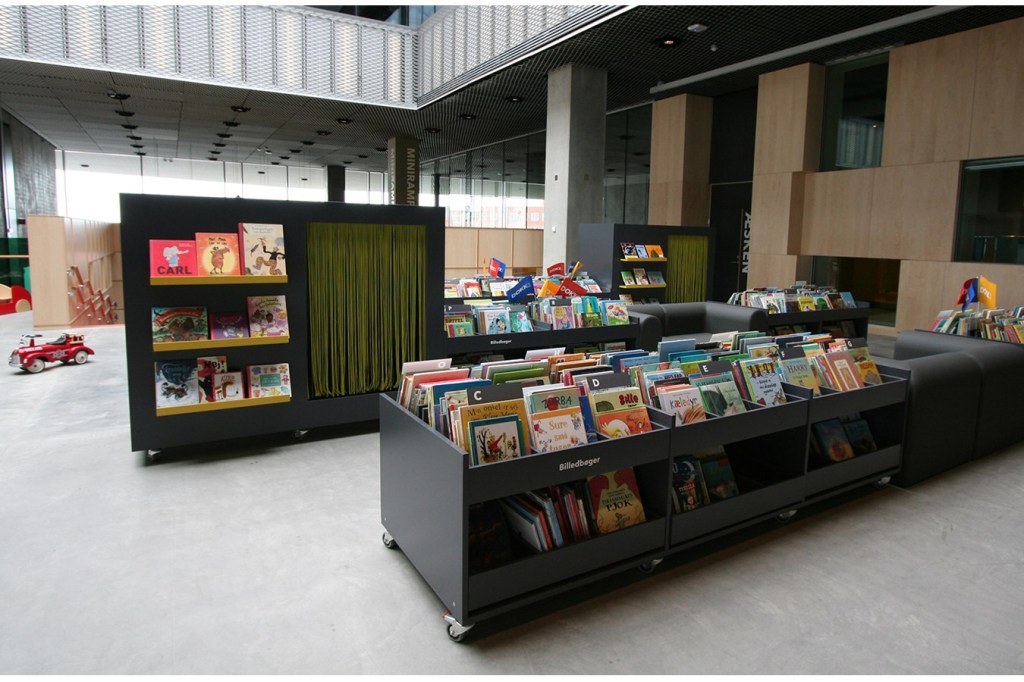

Ever wonder what makes libraries, classrooms, and children’s museums so inviting? Great children’s spaces are accessible, engaging, and inspiring to their visitors. This article takes a look at Dokken, an exemplary Danish library, to see five design principles in action.
A crucial yet underlooked facet of children’s learning and development is the environment, or the space with which a child plays and socializes. Such spaces, like schools or libraries, are not vessels to contain children, but agents that respond, listen, and inspire their inhabitants. Loris Malaguzzi, the founder of the Reggio Emilia educational philosophy, refers to the learning environment as “the third teacher” (with parents being the first, and teachers the second). When you are a children’s literature advocate, you spend a majority of your time thinking about texts: books, movies, television shows. But equally important are the spaces in which these texts are encountered – like libraries, classrooms, playgrounds, or community centers. Put simply, spatial literacy refers to the ability to think critically about the relationships between objects in a space. By developing spatial literacy, we can improve the design and interpretation of these spaces so that they foster communication and growth. This knowledge is not just important for architects or designers, but anyone who works in spaces where children are present.
Using the work of Lella Gandini, another Reggio Emilia educator, I propose 5 questions that may guide a more nuanced perception of children’s spaces. These questions may help an experienced teacher rethink the way they arrange their chairs for small-group discussions, for example. They may encourage a museum educator to incorporate different sensory experiences into an exhibit, such as smell and touch. This article directs these questions to an exemplary case of a children’s space: Dokken, a library in Aarhus, Denmark. Dokken is more than an award-winning public library. It is also a government center and cultural center, a place where people of all ages and nationalities can come to pick up books, lunch, secure a residence card, or crawl up a giant bear overlooking the harbor. While the following questions showcase specific features of Dokken, they also bring attention to the potential of children’s spaces more generally.
1. How does the environment encourage children’s active participation?
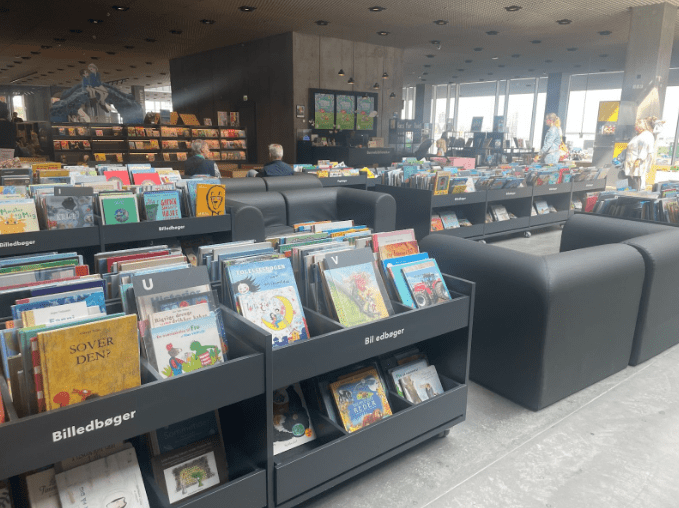
This first question aims to shift conceptions of children as dependents to keep safe to active participants to keep engaged. At Dokken, children are invited to interact with the library at the same caliber as adult visitors. Take the book shelves, for example. Rather than have tall rows of books with their spines sticking out, the children’s shelves are quite low to the ground and their covers face outward. This design impacts the immediacy with which children relate to their environment. Education is not something handed to them by adults, but something they can reach out and grab for themselves. Even the bathrooms, with lowered sinks, mirrors, and toilets encourage children’s autonomy.
2. How does the space offer a multi-sensory experience?
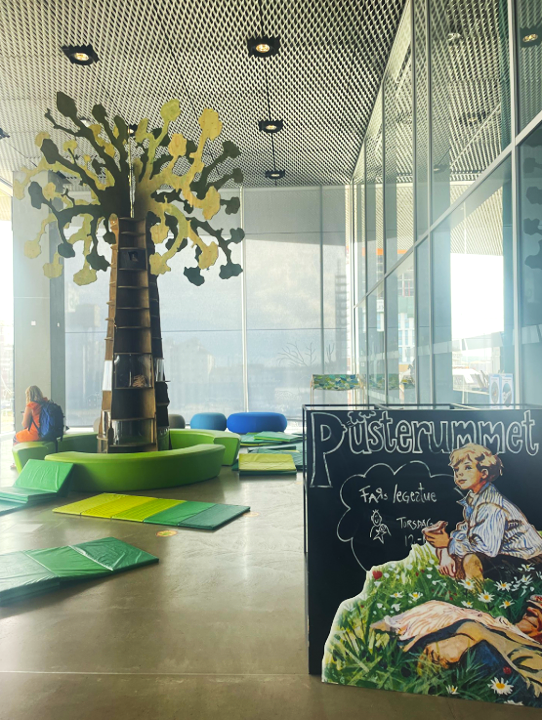
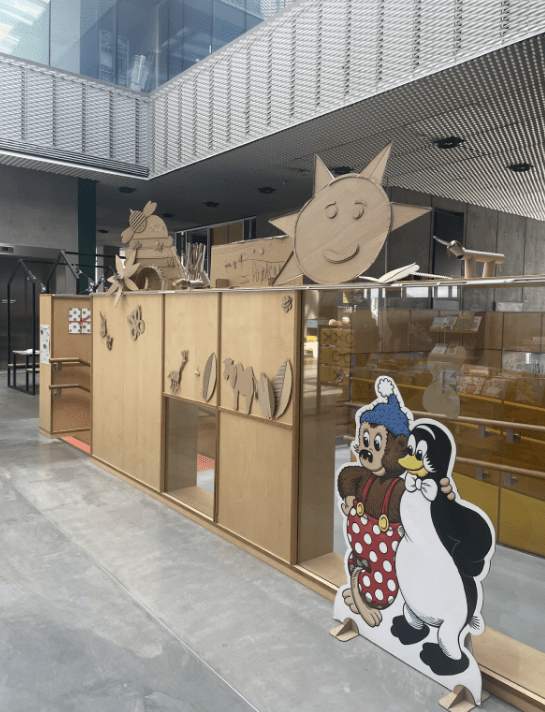
Children thrive in spaces that engage different senses. Dokken stimulates library-goers through a variety of colors, sounds, lighting, and textures. While most of the flooring is hard, gray cement (great for slipping around in socks), other areas are carpeted or padded, which is particularly great for young ones crawling or learning to walk. Large picturebooks offer pops of colors against black shelves, as do cut-outs of popular Danish children’s characters, like the ones in the photo below. These colors shift throughout the day as natural light filters through the building’s tall glass windows. Overhead lighting provides an additional source of brightness. Many of the structures are made of blond wood, such as shadow boxes that may be slid across the ground. Other materials that inspire children’s curiosity include translucent orange glass along a ramp, and puffy blue orbs that can be laid on or pushed.
3. How does the space create opportunities for social interaction?
© Maria Anto, 2025
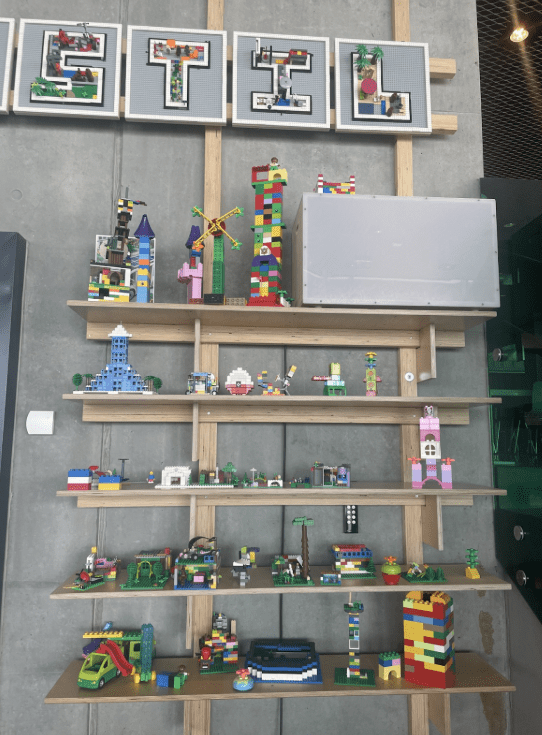
While classrooms on TV are often depicted with straight lines of evenly spaced desks, children’s spaces should encourage small and large group social interaction. At times, I can hardly study at Dokken because of the joyful noise of children digging through Legos, playing, and running around barefoot. While big squares of space, such as a section known as The Workshop, invite large flows of visitors, other sections foster more quiet interactions. In particular, I saw small clusters of children or families nestled into built-in nooks or cozy corners for side-by-side reading. The space is also oriented so that parents can sit and chat with other adults while keeping an eye on their children as they bound from Lego table to book tower. More often, however, I see parents playing alongside their children. Adjustable stools and lowered tables invite more parallel interactions between generations. While there is an emphasis on analog activities like crafting, coloring, and building with Legos, Dokken also offers children digital interactions. One of the busiest parts of the library is a touch-sensored square with an overhead light projection. Children have the ability to select between different games and social activities, such as a football match or dance party.
4. How is the space fluid, or able to be transformed?
Fluidity is also crucial for keeping an environment engaging and alive, especially in spaces that children return to on a daily basis. While the library is quite large, one of the biggest in Scandinavia in fact, there are very few doors. Unlike in other libraries, the children’s section is not a closed off section from the rest of the library. The library uses a semi-open floor plan, giving children access to their own space without distancing them from other library-goers. This openness also creates more possibilities for the space to be rearranged, such as pushing tables or re-orienting shelves. Inside of the library, two sets of ramps increase the fluidity of traffic. In addition to creating visual interest, the ramps are important for welcoming scooters or wheelchairs. Children also seem to enjoy sliding and jumping from one tier to the next. Another aspect that contributes to fluidity in the environment is the library’s floor-to-ceiling windows. Library-goers of all ages can take a break from their reading to watch ships pull in and out of the harbor or the distant beaches and forests. Spatial literacy, therefore, not only takes the physical space into account, but also its surroundings.
5. How does the space reflect the children’s ideas and culture?
©Dokk1
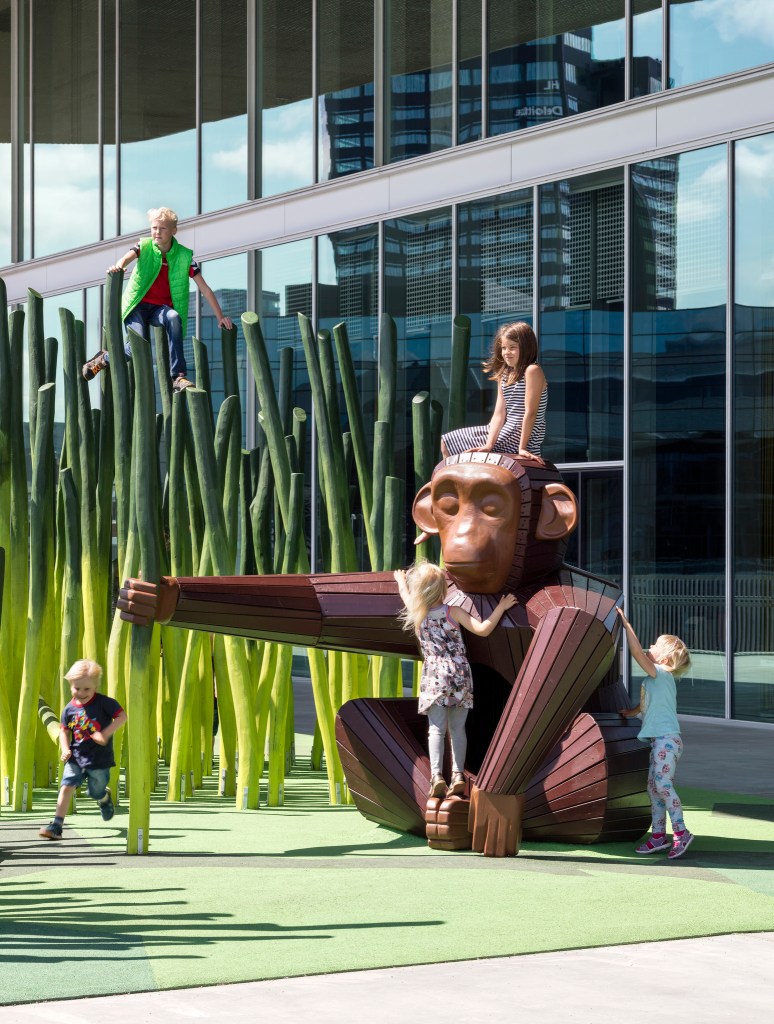
While children are not often consulted in the actual design process, it is important that they feel a sense of belonging in the space – an at-home equivalent might be drawings on the refrigerator or family photos on the wall. At Dokken, spatial features, such as chalkboards and display shelves highlight children’s artwork. By showcasing children’s creations, the environment echoes children’s voices even when they are not present. Other symbols, like a pride flag made of LEGOs or an exhibit on climate change, reflect the community’s values and mission for inclusion. While the space reflects Danish culture through language, character representation, and media, it also presents as an international space. On the balcony surrounding the library’s primary floor, a playground known as Kloden (The Globe) makes reference to different regions of the world – like a bamboo forest and geometric pieces of ice.
By engaging with Dokken through principles of spatial literacy, I hope it appears more than a building where children sit and read books. These concrete examples of Dokken’s architecture and physical features highlight the capacity for children’s spaces to act as a kind of “third educator.” It is my hope that these questions may be applied to other spaces, so that teachers, facilitators, and designers may reimagine the potential of children’s spaces. Of course, not all spaces will have the same funding or modern technology as Dokken. Reorienting the furniture, adding plants for color and study, or putting children’s artwork on the wall may be a first step towards making children’s spaces as special as the children that inhabit them.
Bibliography
- Gandini, L. (2011). Connecting through caring and learning spaces. In C. Edwards , L.
- Gandini & G. Forman (Ed.). The Hundred Languages of Children: The Reggio Emilia Experience in Transformation (pp. 317–342). Santa Barbara: Praeger. Retrieved August 10, 2025, from http://dx.doi.org/10.5040/9798400667664.ch-018
 SLIDING MAGAZINE
Leave a comment