
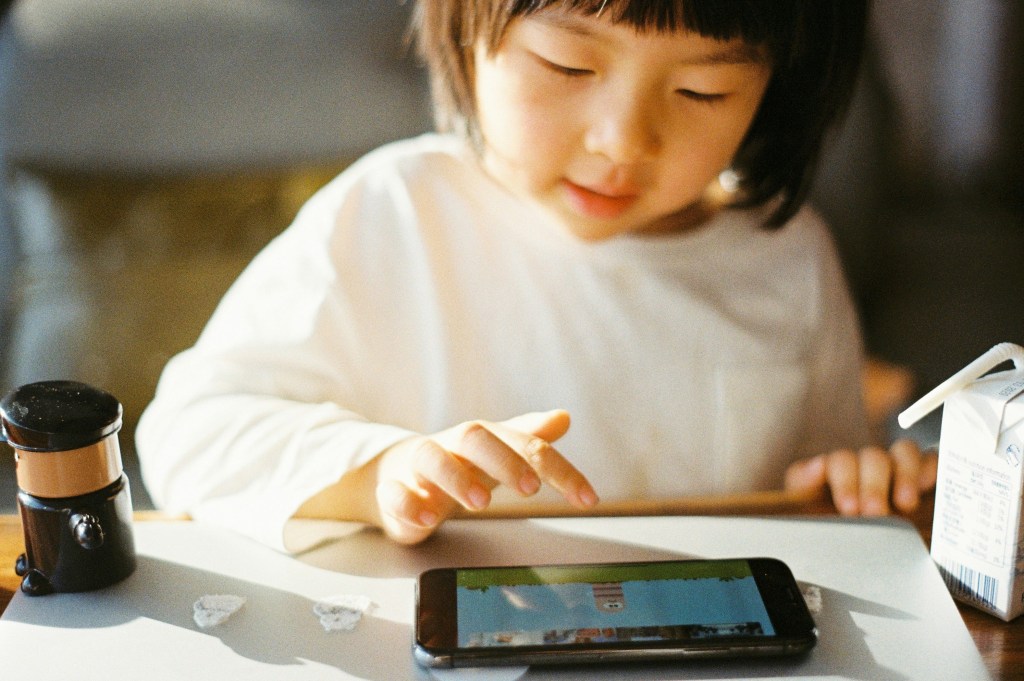

Have you ever wondered about the potential of digital picturebooks for children’s literacy development? Learn more about the intriguing narrative form and its benefits and challenges here.
The rise of digital technologies has brought to life a whole new type of media that combines the text and illustration of a classic picturebook with interactive elements such as sound, animations, and touch-controlled interactions – the digital picturebook (DPB). In this article, I address the potential educational benefits and challenges of these digital, interactive stories.
What is the potential of DPBs and how can they influence children’s (multi)literacy development?
Digital picturebooks have been called the most exciting and scariest innovation in literature for children in a long time. Exciting because the format opens up entirely new hypertextual, multimodal, and interactive possibilities as well as new literary experiences for children. Scary because the impact they have on children’s literary development and early literacy skills is still relatively undiscovered (Yokota & Teale, 2014).
We know that preschool children typically show great enthusiasm when reading digital picturebooks with multimodal features, which in itself is a testimony to their raison d’être, but what do we know about their didactic potential?
First and foremost, research indicates that the multimodal features of DPBs have a positive impact on classic literacy development (reading, writing, and understanding written information) in ways that might even surpass traditional picturebooks. DPB’s functions such as read-aloud and text-highlighting have especially been shown to have a positive impact on young children’s word recognition and story comprehension (If you are interested in learning more about this, you can check out the studies conducted by Bus et al. in 2014, Masataka in 2014, and Zipke in 2016).
Where the DPBs really shine, though, is in the development of literacies that go beyond the written word. Children growing up in today’s increasingly digitised, content-oriented information society are, from an early age, exposed to a whole range of different kinds of media. This means it is no longer enough to be able to read, write, and interpret the written word. To effectively navigate society, one must develop the ability to identify, interpret, create, and communicate meaning across a variety of forms of communication, including visual, oral, corporal, and musical. We can collect such literacies under the umbrella term multiliteracy, and here, DPBs hold great potential. Their multimodal nature introduces children to an interplay between image, text, sound, music, and movement, and reading them is a multisensory practice that engages the body, senses, and surroundings (Pedersen & Have 2023, 53).
That sounds great! Shouldn’t we then just equip all preschool children with digital picturebooks and call it a day?
While DPBs do have a lot of potential, there are also a few challenges to be aware of when it comes to these multimodal, digital narratives.
DPBs often place quite high demands on their young readers’ abilities to decode and interact with their interface. You have to know where to press to make things happen and to move the story forward. Hypermedia elements such as hotspots and games might interrupt the narrative, placing demands on the child’s ability to navigate a non-linear narrative structure. It is therefore generally helpful – and in some cases even necessary – to have an adult mediator who can support and guide the child reader through the story and its interactive and multimodal features.
It is also important to be aware that while some multimodal elements can have a positive effect on learning, others, such as games and hyperlinks, might lead to cognitive overload. This term refers to the required tasks and amount of information being too much for the child to process and handle. Some DPBs can potentially overwhelm the child reader and have a negative impact on their learning – depending on the child’s age and mental capacity.
Okay, but how do I then know which digital picturebooks will cause cognitive overload? (and other important questions we still need an answer for)
The arguments I have made in this article are based on existing interdisciplinary research that draws on a wide range of theoretical fields, but at this point in time, research is still relatively limited and we have yet a lot to learn. How do different multimodal and interactive elements, for instance, affect the reading experience? What role does the medium through which the story is presented play in the way a story is read and experienced? And, more generally, how do these multimodal and interactive stories influence children’s attention span and ability to concentrate and immerse themselves in a story?
DPBs are super diverse in their form and the way they function, so it must always be an individual assessment whether a story fits a specific educational purpose and target audience.
One of the recurring aspects that scholars in the field emphasise is the importance of good-quality DPBs, if they are to improve literacy and provide meaningful experiences for the child reader. This raises the important question: What makes a good-quality digital picturebook, and how do I find one? Personally, I am still early in my journey of exploring the world of DPBs, but I have compiled a small list of resources for you to check out:
PIBOCO

- A great, ad-free platform filled with good-quality DPBs that use sound, music, animation, and touch-based interaction
- New stories weekly
- Easy and accessible interface
- Target audience: 3-8 years
- Available in six languages: German, French, Danish, Spanish, Italian, and English
- 7-day free trial followed by a monthly 6.49 USD subscription or a yearly 37.99 USD subscription
Storyline Online

- Videos featuring actors reading books aloud alongside animated illustrations
- Target audience: 3-8 years
- Only available in English
- Free to use
Vooks

- Tons of animated read-aloud books for children
- Free printable and video resources to support the reading
- Target audience: 3-8 years
- Mainly books in English, with a selection of titles and bilingual DPBs in Spanish
- 7-day free trial followed by a monthly 9.99 USD subscription or a yearly 49.99 USD subscription
Inanimate Alice
- A multimodal, interactive, and immersive tale of a girl dreaming of becoming a game designer
- Target audience: 10-14 years
- Paid membership with different subscription options
If you know of others – both resources about DPBs and specific books – please feel free to leave a comment or reach out to me! I am always on the lookout for new exciting platforms and stories.
Bibliography:
- Bus, Adriana G., Zsofia K. Takacs & Cornelia A. T. Kegel. (2014). Affordances and Limitations of Electronic Storybooks for Young Children’s Emergent Literacy. Developmental Review 35, 79-97. http://dx.doi.org/10.1016/j.dr.2014.12.004
- Masataka, N (2014). Development of reading ability is facilitated by intensive exposure to a digital children’s picture book. Frontiers in psychology, vol 5, 396-396. http://dx.doi.org/10.3389/fpsyg.2014.00396
- Pedersen, B.S., and Have, I. (2023). Reading toward multiliteracies: understanding reading comprehension and reading experience. In Engberg, M., Have, I. & Pedersen, B (ed.) The digital reading condition. Routledge. https://doi.org/10.4324/9781003211662
- Yokota, J, and Teale, W.H. (2014). Picture Books and the Digital World: Educators Making Informed Choices. The Reading Teacher (67)8, 577-585.https://doi.org/10.1002/TRTR.1262·
- Zipke, M. (2016). Preschoolers Explore Interactive Storybook Apps: The Effect on Word Recognition and Story Comprehension. Education and Information Technologies 22(4), 1695-1712. 10.1007/s10639-016-9513-x
 SLIDING MAGAZINE
Leave a comment