The majority of bisexual representation is, simply said, worrying. Many authors still commonly fall back on bisexual stereotypes, such as hypersexuality and confusion, or bisexuality is not mentioned as an option at all.
With a growing representation of queer stories, one group is clearly missing in Young Adult literature: bisexual youth. Even when their stories are told, the majority of bisexual representation is, simply said, worrying. Many authors still commonly fall back on bisexual stereotypes, such as hypersexuality and likening being bisexual to being confused. Often, bisexuality is not mentioned as an option at all.
For teens, the inclusion of bisexual characters can “be their sliding glass doors into a queerer world and a more complete understanding of themselves” (Knopp-Schwyn and Fracentese, 2019). Bisexual teens can benefit from seeing themselves reflected in these stories. The media can thus play a significant role in shaping a teenager’s self-view. If one only sees negative and stereotypical portrayals of their sexual orientation, this can lead to internalized biphobia (Allen, 2022). Positive portrayal of bisexuality not only helps against internalized negativity, but also works as a force against the othering of bisexual people in real life.
This proper and necessary representation in children’s literature is not yet present, which suggests that bisexuality is not yet an accepted sexuality, or at least not acceptable enough for literary publishing. Novels still often align with heteronormative ideals of monosexuality and monogamy. In contrast, bisexuality is a threat to these “traditional sexual norms” (Erickson-Schroth and Mitchell, 2009). Bisexuality is often seen as “too queer” for the literary world (Epstein, 2012). Therefore, you often see more representation for lesbian and gay identities rather than representation of bisexual and gender diverse characters
This considerable problem in the portrayal of bisexuality in children’s and YA novels may partly be caused by the genre’s focus on monogamous relationships. This erases the “plurality” of bisexuality (Kneen, 2014). Unless specifically mentioned within the novel, bisexuality is either not noticeable or too vague to recognize. Epstein exemplifies these issues in characters who are single and not dating or a character in a long-term straight relationship (2014).
Coletta describes this phenomenon as ‘unintended bi-erasure’ (2018). This suggests that a character’s imagined sexuality is based on the gender of their partner. Characters in a monogamous relationship with a character of the opposite gender are considered heterosexual. In contrast, characters in a monogamous relationship with a character of the same gender are considered homosexual. Epstein mentions that characters are put in this monosexual box, “rather than being [considered] genuinely bisexual all the time” (2014). Bisexuality as a valid option thus disappears between the written lines.
Another aspect of this bi-erasure is the fact that authors often do not use the word bisexual. An argument against the importance of this can be that bisexuality should be normalized, and therefore, there should be no necessity to name it specifically (Epstein, 2014). Heterosexual as the norm needs no naming, while queer sexualities, including bisexuality, are “othered” by specifically noting them (Knopp-Schwyn and Fracentese, 2019).
When bisexual characters are included and named, the representation is still somewhat questionable. The repetitive use of stereotypes only shows one possible bisexual story. Due to this, not many novels break Adichie’s concept of the ‘single story’ (2009). This means that while the singular, stereotypical story that gets told may be a representation of some bisexual people’s experiences, it fails to explore the variety of other realities. It fails to show the plurality of experiences. This is once again demonstrated in the study of intersectionality within bisexual novels. Nearly none of the studies comment on it, but by looking at the novels the scholars analyzed, it becomes clear that they mainly include white, middle-class, cisgender characters.
The novels often follow predictable, stereotypical plots and relationships. Bisexual characters are shown to be indecisive, attention-seeking, confused, hypersexual, untrustworthy, and unable to commit. In relationships, bisexual people are also shown as unfaithful (Allen, 2022; Hutchins, 1996; Kneen, 2014; Knopp-Schwyn and Fracentese, 2019; Ochs, 1996; Knopp-Schwyn and Fracentese, 2019). These stereotypes, together with the problematic understanding that bisexual people must be polyamorous, form a threat to the “supermonogamous ideal” of YA literature (Knopp-Schwyn and Fracentese, 2019). Hutchins also writes that fictional bisexual people are often forced to pick between heterosexuality and homosexuality or explore those sexualities before accepting themselves as bisexual (1996). Additionally, from a heterosexual point of view, bisexuality can be seen as a trendy identity besides being just a “phase” (Erickson-Schroth and Mitchel, 2009).
The research on bisexual representation provides a straightforward solution to the problematic portrayal of bisexuality in YA literature: name bisexuality. Normalization and equalization start by acknowledging the possibility of a character being bisexual (Coletta, 2018; Knopp-Schwyn and Fracentese, 2019). Coletta adds that “young LGBTQ readers” on social media voice their need for such representation (2018). Though it may feel like name-dropping to authors, naming a character’s bisexuality is of importance to the real-life acceptance of the identity. Knopp-Schwyn and Fracentese introduce rules of representation that can apply to YA literature. They state that a character must:
(a) be shown to have romantic or sexual attraction, or the possibility of romantic or sexual attraction, (b) to multiple characters, (c) of more than one gender throughout the story, and (d) without the text authoritatively negating the character’s existence as bisexual. (Knopp-Schwyn and Fracentese, 2019).
This does not mean that the character has to be in multiple relationships throughout the story. If an author aims to avoid a romantic plot, simply adding romantic attraction or “desire” to multiple genders can be enough (Kneen, 2014).
The research on bisexual representation provides a straightforward solution to the problematic portrayal of bisexuality in YA literature: name bisexuality. Normalization and equalization start by acknowledging the possibility of a character being bisexual
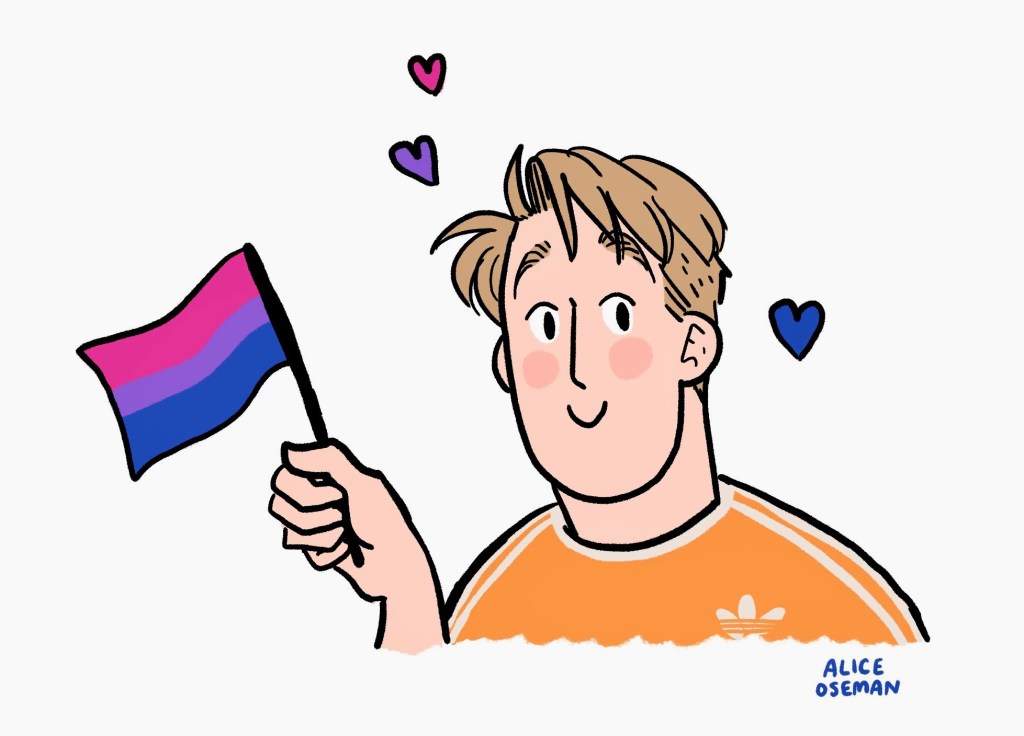
To end on a positive note: while this article primarily shows the negative portrayal of bisexuality in YA literature, there are examples of novels that succeed in representing bisexual joy. A good example is Alice Oseman’s Heartstopper series (2016-). The graphic novels tell the story of the developing relationship between a gay boy and a bisexual boy who are surrounded by a racially, gender, and sexually diverse friend group. Novels like these can help defy stereotypes and make bisexual people feel heard.
Allen, M. (2022) “In a romantic way, not just a friend way!”: Exploring the developmental implications of positive depictions of bisexuality in Alice Oseman’s Heartstopper. Journal of Bisexuality, 23(2), 197–228. https://doi.org/10.1080/15299716.2022.2153191
Coletta, J. (2018) The missing B word: Compulsory binarization and bisexual representation in children’s literature. Jeunesse: Young People, Texts, Cultures, 10(1), 85–108. https://doi.org/10.1353/jeu.2018.0004
Erickson-Schroth, L., and Mitchell, J. (2009) QUEERING QUEER THEORY, OR WHY BISEXUALITY MATTERS. Journal of Bisexuality, 9, 297–315.
Hutchins, L. (1996) Bisexuality: Politics and community. In Firestein, B. A. (Ed.), Bisexuality. London: Sage, 240-259.
Kneen, B. (2014) Neither very bi nor particularly sexual: The essence of the bisexual in Young Adult literature. Children’s Literature in Education, 46(4), 359–377. https://doi.org/10.1007/s10583-014-9237-8
Knopp-Schwyn, C. and Fracentese, M. (2019) Challenges and possibilities for bisexual Picturebooks. Journal of Bisexuality, 19(3), 414–439. https://doi.org/10.1080/15299716.2019.1649228 Ochs, R. (1996) Biphobia: It goes more than two ways. In Firestein, B. A. (Ed.), Bisexuality. London: Sage, 217-239.


 SLIDING MAGAZINE
Leave a comment