

A brief reflection about neurodiverse representation and two approaches to female autistic tweens in A Kind of Spark and Ellen Outside the Lines.
Themes around diversity and disability in children’s books have shown to be on the rise. It might not be too difficult to find a disabled character, but characters that embody more than one identity are scarce (Kingsbury, 2021). In this article, I aim to compare two books that contain a tween (pre-teen) autistic female protagonist, focusing on how the books present and explain autism to their intended reader. Both texts, A Kind of Spark (2021) and Ellen Outside the Lines (2022), are quite recent and centre around their female characters’ struggles with being an outcast while growing up. However, the challenges that each protagonist faces are very different.
A Kind of Spark focuses on Addie’s relationships with her peers at school, as well as with the adult members of her community. She is trying to put up a memorial for the witch trials carried out in Juniper after learning about them and strongly empathising with the women’s suffering. Addie tells her story and the difficulties she faces daily, being an autistic girl in a neurotypical world, linking her experiences with those of the women unlawfully persecuted in medieval times; she is constantly misunderstood and misinterpreted by the adults around her, and awfully picked on and isolated by her peers.
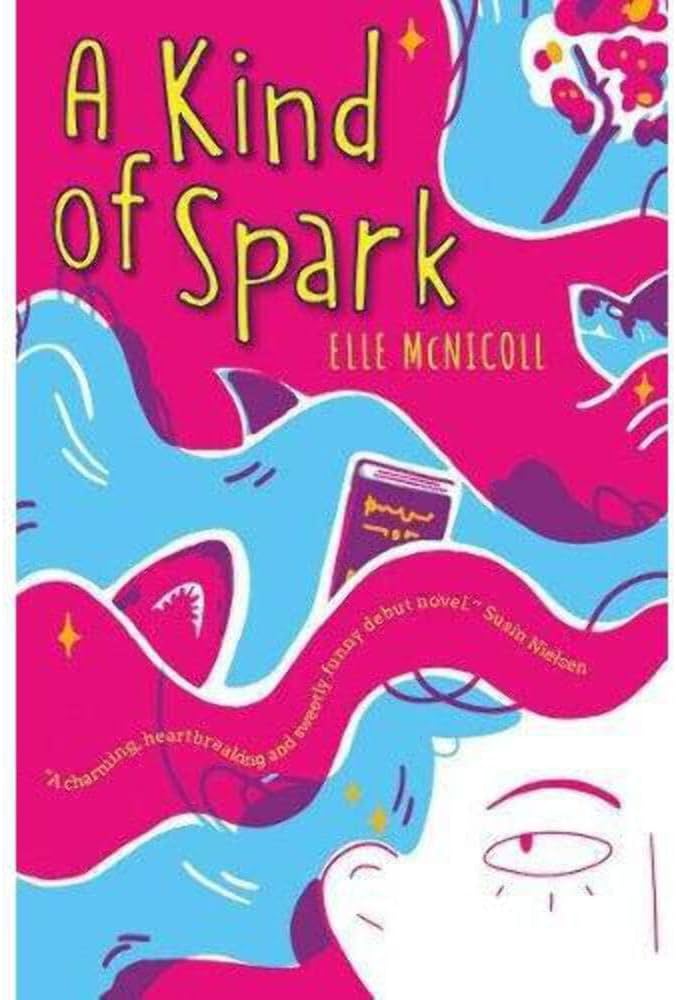
Throughout the book is possible to see different attitudes regarding disabilities. This issue comes from most of the adults surrounding Addie, who tend to be condescending towards her because of their prejudices against autistic people. Nonetheless, it is important to distinguish that these attitudes come from characters outside of Addie’s family. Her immediate relatives are insiders in disability culture, and so are supportive of Addie, her ideals and advocacy for the victims of the witchcraft trials.
The author uses different characters to portray common prejudices about autism. For example, Mr. Macintosh, who actively opposes Addie’s petition for a memorial for the witches’ trials, holds a condescending attitude towards her. He assumes that because she is autistic, she can’t come up with such an idea herself. Therefore, an older figure, such as Addie’s older sister, Kiddie, must be manipulating her into pushing this idea as her own. Ms. Murphy, Addie’s teacher, believes that autism is an intellectual disability. Moreover, she expresses that Addie is a danger to her and the other children in the class and should be institutionalised. Emily, Addie’s classmate, actively bullies her because of her interests and behaviours.
A Kind of Spark has a clear educational purpose. It not only takes on Addie’s point of view so the reader can empathise with her (Abad, 2021), but constantly uses terms to accurately represent the daily experiences of an autistic person. The goal of the book is for the reader to learn and understand autism, having it explained in first person. The way the author does this is by having Addie explain terms such as ‘masking’ during internal monologues. However, it is important to consider that this strategy interrupts the flow of the narrative, as it has a similar effect to breaking the fourth wall, with Addie explaining something that is already well understood by her but might be new to an implied reader. Sapp (2010) emphasises that obvious didacticism may have a negative impact on reading motivation, as readers can perceive it as condescending, failing to create a compelling story.
On the other hand, Ellen Outside the Lines takes a very different approach, showing Ellen’s autism as a part of a complex identity; she is also a 12-year-old lesbian and Jewish girl. Throughout the book, it is possible to see her interacting with her parents while speaking in Hebrew, discussing the significance of religious practices, and sexuality. This goes to show that, while autism is a theme across the story, it is not the only one.
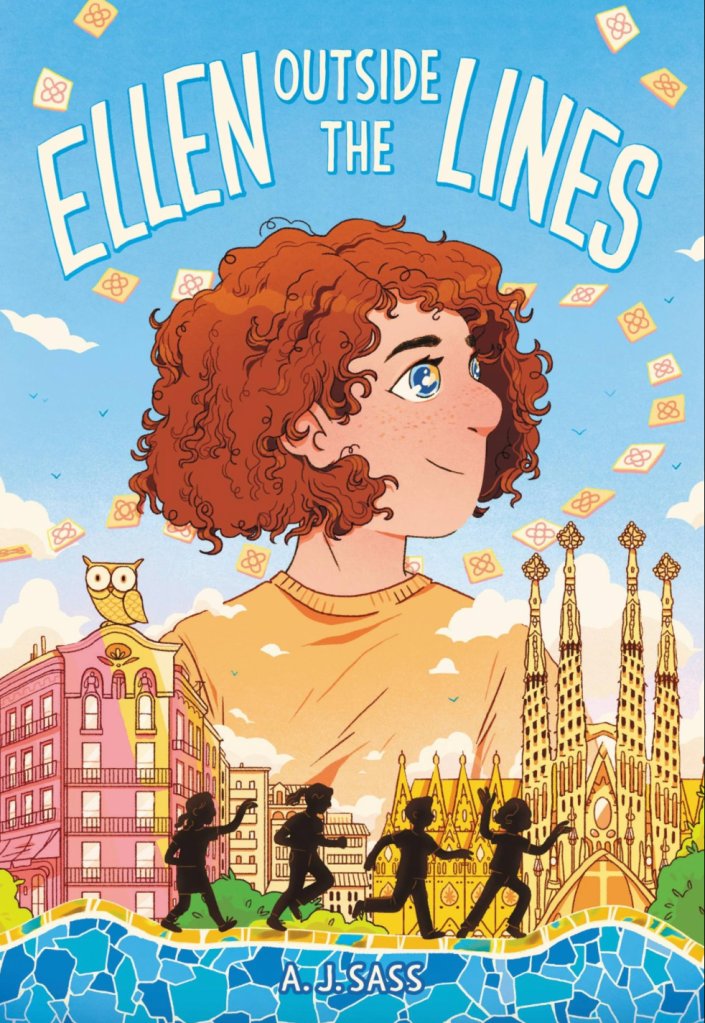
LGBTQ+ identities are an important part of the story, given that Ellen has a special interest in the different use of pronouns across different languages. Isa’s non-binary identity, although surprising for Ellen, is shown as simple to respect. Even with these discussions about queerness, the main theme of the narrative is friendship.
Early on, we learn that Ellen is growing apart from her childhood best friend, who now has a new friend group, with whom they share a lot of personal interests. This scares Ellen, as change is something complicated for her, but she is also not sure if she can make other friends. When assigned to a group at random, Ellen is unsure about how to interact with them, and is constantly stopping herself from flapping her arms and other soothing mechanisms. Nonetheless, as time goes on, she becomes more comfortable and learns important things about her group. Gibs was recently diagnosed with ADHD, and Isa and Andy are both queer, allowing them to grow closer.
Ellen shows signs of autism from the starting point in the narrative, like her affinity for rituals and scheduling, therapy, her sensitivity to loud noises, and some difficulties reading social cues. Initially, Isa notices that Ellen struggles to understand puns, and they take the time to explain them to her. However, Isa did not know Ellen was autistic until she experienced a meltdown in front of the group and later decided to explain to them what happened. This is followed by Isa asking if she knows of ways to prevent it.
Ellen Outside the Lines offers a different story about autism, stepping away from the common topics that fill stories about characters living with disabilities, where bullying and acceptance become the main plot (Webb, 2017). In this story, we follow Ellen as she comes to understand how friendships change and develop.
Moreover, in comparison to A Kind of Spark, Ellen’s explanation of a meltdown not only seems natural within the story but also helps to show how the bond between characters is strengthened with these interactions. Through their desire to know and understand each other, the characters get involved in complex conversations about identity and social expectations. This highlights the importance of diversity and intersectionality within disability representations. These themes are essential in coming-of-age stories and help widen the public’s understanding of autism, as well as allowing children to identify with these stories in multiple ways (Webb, 2017).
Having established this, it is crucial to highlight how both A Kind of Spark and Ellen Outside the Lines step away from common tropes within depictions of disabilities. Especially when it comes to autism, as the characters in these stories tend to be ‘white and cis male, with an emphasis on social cluelessness, rigid habits and rituals, a lack of empathy, an analytical mind, a high IQ, and a matter-of-fact tone and/or derivative way of speaking’ (Coussy, 2022, p. 6). Through these stories, both authors offer a refreshing perspective of autistic girls and the hardships they go through, as ‘the social conditioning of girls, with its emphasis on people-pleasing and self-erasure, leads to an invisibilisation (i.e., an erasure) of their neurodivergence’ (Coussy, 2022, p. 8).
On the one hand, A Kind of Spark focuses on educating its readers on what autism is, while showing different misconceptions about it, and showing them to be untrue through Addie’s internal monologue and actions.
On the other hand, Ellen Outside the Lines focuses on how Ellen understands and deals with multiple identities. While is made noticeably clear she is an autistic queer girl, the story focuses on her dealing with change. Sass amplifies the story of Ellen to a degree that can allow non-neurodivergent readers to recognise themselves in her as well (Coussy, 2022). Identity and community play a crucial role in the narrative, and these are issues that most pre-teens begin to question as they grow up, making the book relevant not only for its autistic representation.
“neurodivergent children also need stories that not only focus on intolerance and overcoming adversity but on having new experiences that take into consideration the complexities of a person’s identity”
Considering all perspectives, both books take a different approach to autistic representation, as it has been established that there is not just one autistic experience, but every person has a singular one. However, it is important for books with autistic representation to expand towards multiple identities when it comes to inclusivity (Kingsbury, 2021). Disabled and neurodivergent children deserve a multitude of stories. While a label such as ‘autistic’ can help them understand themselves and their sense of identity, we ought to acknowledge their stories further. As well as queer characters deserve storylines that not only revolve around them fighting homophobia, neurodivergent children also need stories that not only focuses on intolerance and overcoming adversity but on having new experiences that take into consideration the complexities of a person’s identity.
Bibliography:
Primary
- McNicoll, E. (2020) A Kind of Spark. 1st ed. London: Knights Of Media.
- Sass, A. J. (2022). Ellen Outside the Lines 1st ed. Little, Brown and Company.
Secondary
- Abad, J.M. (2021) ‘The Paratextual Labelling of Autistic-Authored YA Fiction as #OwnVoices: How YA Literary Culture Creates Space for Neurodivergent Authorship’, Disability Studies Quarterly, 41(2). Available at: https://doi.org/10.18061/dsq.v41i2.7050.
- Coats, K., Stevenson, D., & Yenika-Agbaw, V. (Eds.). (2022). A Companion to Children’s Literature. John Wiley & Sons.
- Kingsbury, M. (2021) ‘The Current State of Disability Representation in Children’s Books’, BOOK RIOT, 28 April. Available at: https://bookriot.com/disability-representation-in-childrens-books/ (Accessed: 18 January 2024).
- Sapp, J. (2010). A review of gay and lesbian themed early childhood children’s literature. Australasian Journal of Early Childhood, 35(1), 32-41.
- Webb, J. (2017). Health, Sickness and Literature for Children. The Edinburgh Companion to Children’s Literature, 281-288.
- Wheeler, E. A. (2022). Disability. In K. Coats, D. Stevenson, & V. Yenika-Agbaw (Eds.), A Companion to Children’s Literature (First, pp. 330–340). John Wiley & Sons.
 SLIDING MAGAZINE
Leave a comment