
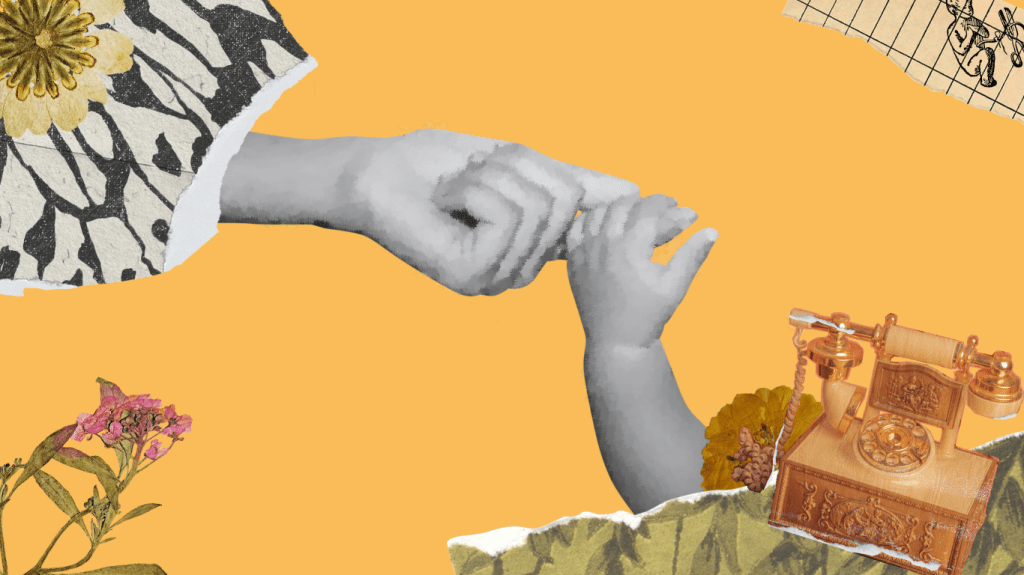

This curated selection of picture books explores the complexity of mother-daughter bonds. Beyond idealized portrayals, these stories create a safe space for shared reflection, helping mothers express emotions and mediate their daughters’ questions about womanhood while nurturing mutual understanding across generations.
Psychoanalytic theory imposes a tragic order upon women: there is no way to become a woman without separating from the mother, which is a necessary condition to enter the symbolic, or the masculine order (Rich 1996, cited in Trites, 1997:237). According to Cixous et al. (1976), this tragedy occurs when a female tries to insert herself in the masculine order at the cost of disconnecting from her body, desires, feminine language, and her intrinsically rhythmic and creative nature.
Cixous et al. (1976) argue that an embodied female can only fully express herself through a feminine language— a language inaccessible to men, just as women can never fully access the codes of the masculine order. For her, as all embodied women have the biological capacity to become mothers, they write to varying degrees with “white ink” (p. 881). According to this, the female body is a living text, and the ambivalent, fluent, and creative voice of her internal mother moves her forward to resist and fight the oppositional forces of patriarchy. But how does a girl learn what it means to be female? How does she name the complexities of her being and the meanings she senses are in constant negotiation? Through observing her mother. And what tools does the mother have to express and teach the many nuances of the role she embodies, beyond simply being herself?
Children’s literature comes to be a tool to construct the female experience both in the masculine and feminine language. According to McAdam et al. (2020:386), children’s literature provides readers with an opportunity to engage in dialogue, analysis, and imagination while equipping them with tools to navigate the world and shape their actions. From this perspective, children’s literature can be seen as a utopian space, one capable of inspiring hope for new ways of being or fostering a deeper understanding of the diverse perspectives that shape the society in which we live.
Picture books about the mother-daughter relationship, embody Bishop’s metaphor of mirrors, windows, and sliding glass doors, often within the same reading experience. As a mirror, the young female reader sees in her mother part of her identity, her preferences, and personal motivations. As a window, she observes her mother doing and feeling things that are still beyond her own experience. Crossing the threshold of the door, she begins to understand more deeply the nuances and variations of her mother’s character—her life beyond the maternal role, where she exists as an entity without needing to “other” herself to fit that role.
The selection process of the books was carefully conducted to avoid falling into what Nikolajeva (2002:116) refers to as the “all-too-simple condemnation of gender stereotypes in children’s books.” This means that books were not excluded simply because they portrayed mothers performing traditionally gendered tasks such as cooking, comforting, or caring, as long as the portrayal included the mother’s voice reflecting her choices or challenges in assuming that role. Moreover, the portrayal of the mother engaging in these activities was considered within the narrative’s perspective, acknowledging that, as Nikolajeva points out, the focus on certain tasks may be determined by the child’s point of view and may not capture the full complexity of the mother’s role beyond these activities.
The curation on Mothers and daughters that I expose here is a selection of 33 picture books that portray the nuances of motherhood and the position of the female child as an observant and collaborator in the mother’s life and were categorized into six plot themes: i) Caring and Observant Child; ii) Diverse Motherhood; iii) Hero Mom; iv) Mama Feels; v) Intergenerational Relationships; and vi) Identity Construction. Some of the books overlap in themes, but each is assigned to the category that best reflects its core message.
1. Caring and observant child
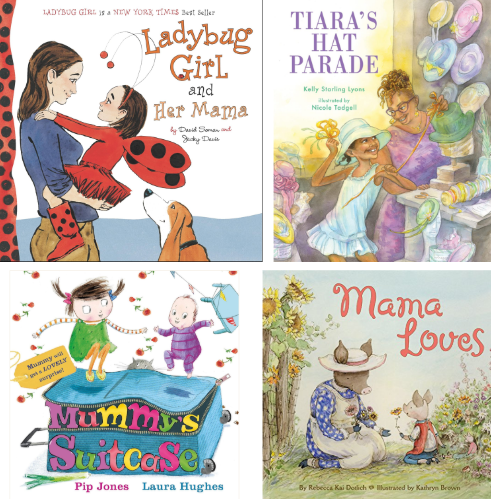
The picture books selected for this category depict thoughtful children, who actively observe, and care about their mother’s tastes, emotions, and desires. They perform tasks aimed at empathizing with their mother’s state of being or serving them in some way. In these picture books, we see a little girl creatively saving her mother’s business in Tiara’s Hat Parade, an excited girl who has carefully planned the best day with her mom in Ladybug Girl and Her Mama, a girl who packs everything her mom needs for a well-equipped trip in Mummy’s Suitcase, and a recount of the many things a mother loves to do and try, beyond just caring for her children, in Mama Loves.
2. Diverse motherhood
This theme presents eight picture books about motherhood across cultures, family structures, and backgrounds. Related to cultural backgrounds, Mommy’s Khimar, Mama, Do You Love Me?, and Your Mama depicts a Muslim American girl proudly wearing her mother’s khimar, an Inuit girl challenging her mother’s boundaries and love, and a Latin American girl following and admiring the many facets of her mother.
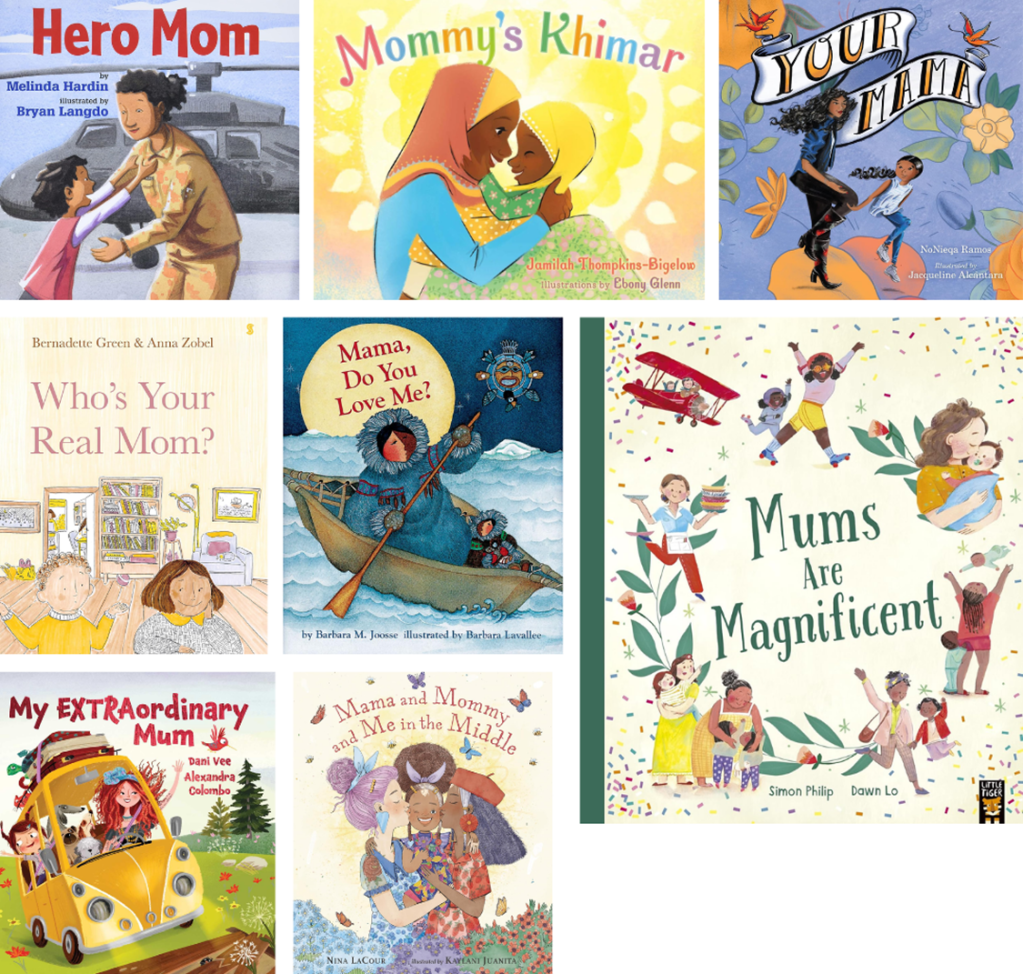
This category also includes books related to queer motherhood such as Who’s Your Real Mom? and Mama and Mommy and Me in the Middle. These books are not only relevant for portraying caring and agentic lesbian mothers but also for depicting daughters who have agency, are comfortable within their family structure, and actively defend it. Moreover, these stories do not diminish or invalidate the expressions of love between family members.
Finally, this category includes picture books that show mothers from different backgrounds or occupations, demonstrating that, in addition to the expected acts of care, mothers also lead public lives that generate challenges and admiration from the observant child. These books are Hero Mom— featuring a mother who is part of the U.S. Army—, Mums Are Magnificent —a collection of moms with diverse perspectives of life and occupations—, and My EXTRAordinary Mum— depicting an adventurous and free-spirited mother.
3. Hero mom
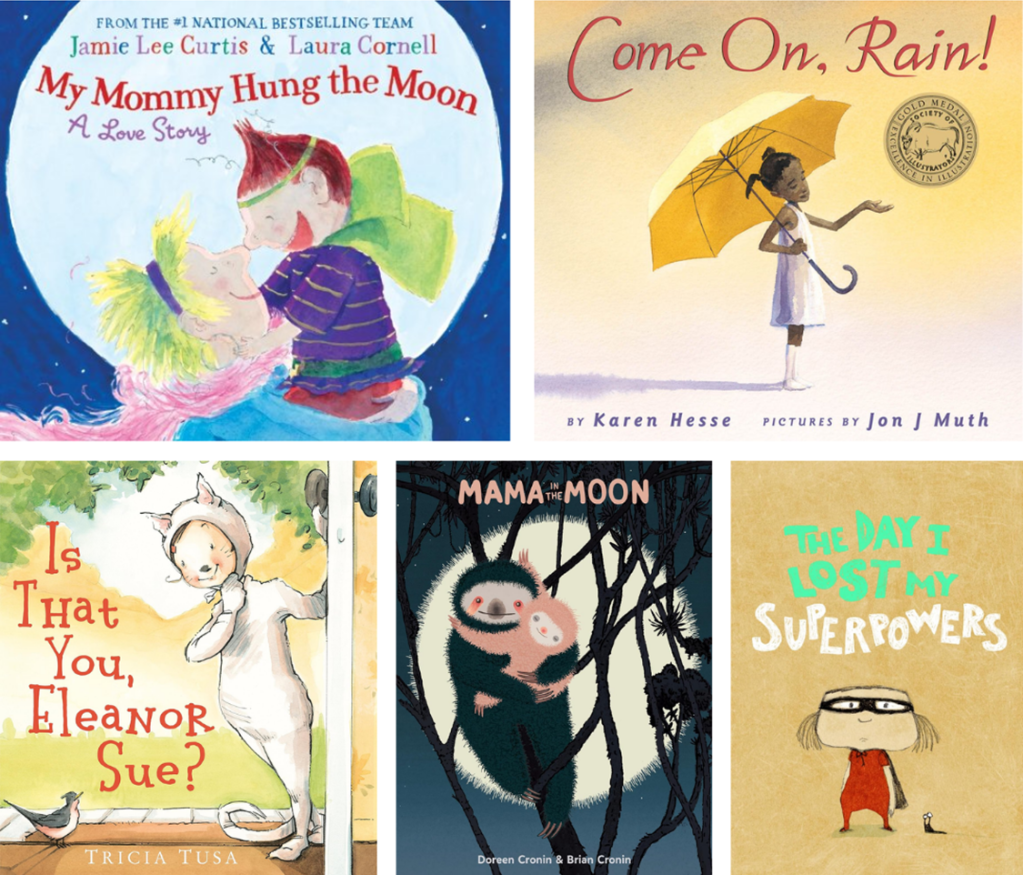
From children’s perspectives, a mother’s acts of care and protection might seem like the funniest and most magical events they have ever experienced. This is a common depiction of motherhood in picture books; however, such portrayals can sometimes overly romanticize the perks of being a mother. In this selection of picture books, the heroic acts seen by the child are not detached from the mother’s personality, nor are they solely depicted to serve the child.
In My Mommy Hung the Moon: A Love Story, the child believes her mom has created the universe while she performs many tasks. In Mama in the Moon, a sloth mother helps her child navigate fear, while she can reach her. In The Day I Lost My Superpowers, a mother observes her child through the day’s challenges, sometimes disapproving of her behaviour; however, she heroically steps in when her daughter’s superpowers are not enough to heal herself. In Come On, Rain!, and Is That You, Eleanor Sue?, we see playful moms who turn an ordinary day into something fantastic, enjoying their activities while fostering their child’s imagination and fun.
4. Mama feels
Mothers feel more than love and react in diverse ways to their children’s behaviour and external stimuli. The picture books grouped in this category show a varied depiction of how mothers navigate their emotions and come to recognize or claim the importance of rest and personal space. This category includes three Spanish-language picture books, that explore the mother’s emotions: Madrechillona—which could be translated into English as Yelling Mother— talks about a penguin mom who gets desperate and with a scream breaks her child apart. When she acknowledges what has happened, she recovers all the pieces and heals her child and their relationship. In the beautifully illustrated picture book Madre: Entre el Día y la Noche— Mother: Between Day and Night—, we are introduced to a mother who navigates the light and darkness of her emotions, and how her relationship with her daughter mutates in response to them. A Veces Mamá Tiene Truenos en la Cabeza— Sometimes Mommy has a Storm on Her Head—, uses images such as clouds, rain, sun, rainbows, stars, and thunder to depict the various emotional stages of a mother, while the child recognizes that she navigates the same emotional seasons from time to time.
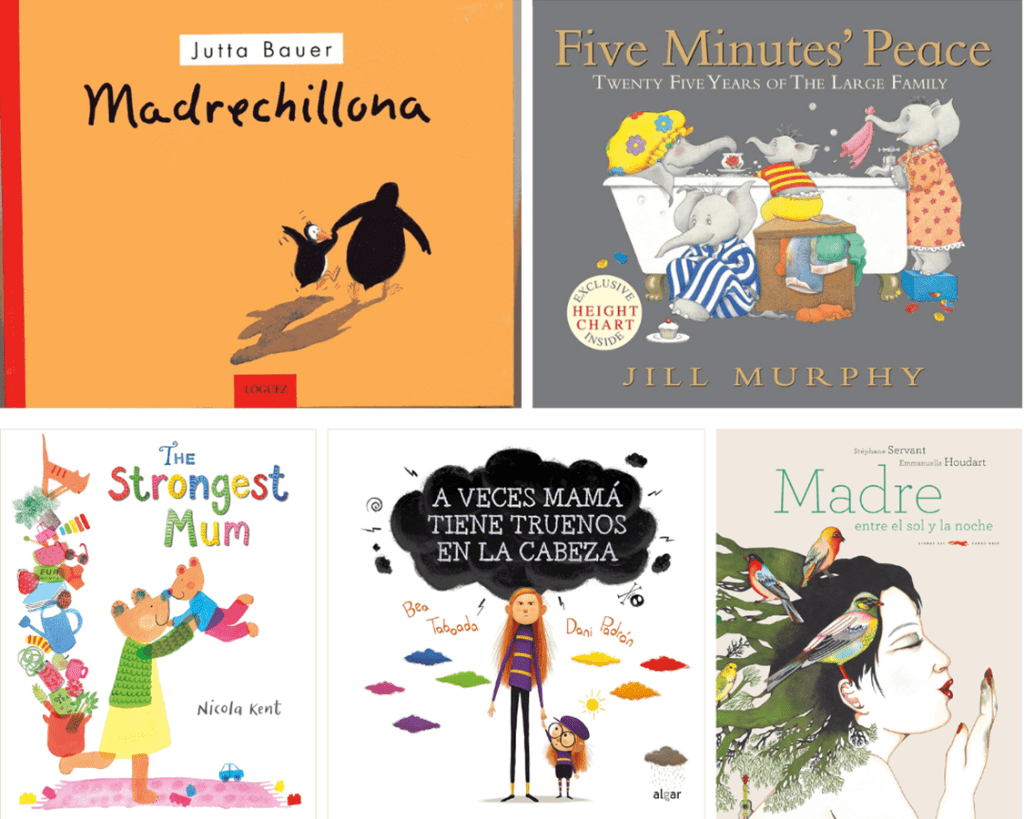
In contrast, the two English-language picture books focus more on personal space and the recognition of the need for rest. In Five Minutes’ Peace, an elephant mother asks for five minutes of rest from her children. Even though her three children are not able to understand her requests and boundaries, the picture book ensures the reader understands the importance of her demand and how, sometimes, even the cutest gestures from children are not enough when one needs rest. In The Strongest Mum¸ a mother helps to carry everyone’s stuff until the load is too heavy, she collapses. After a good time of rest and help from her daughter and neighbors she is able to return to her normal self, active and playful.
5. Intergenerational relationships
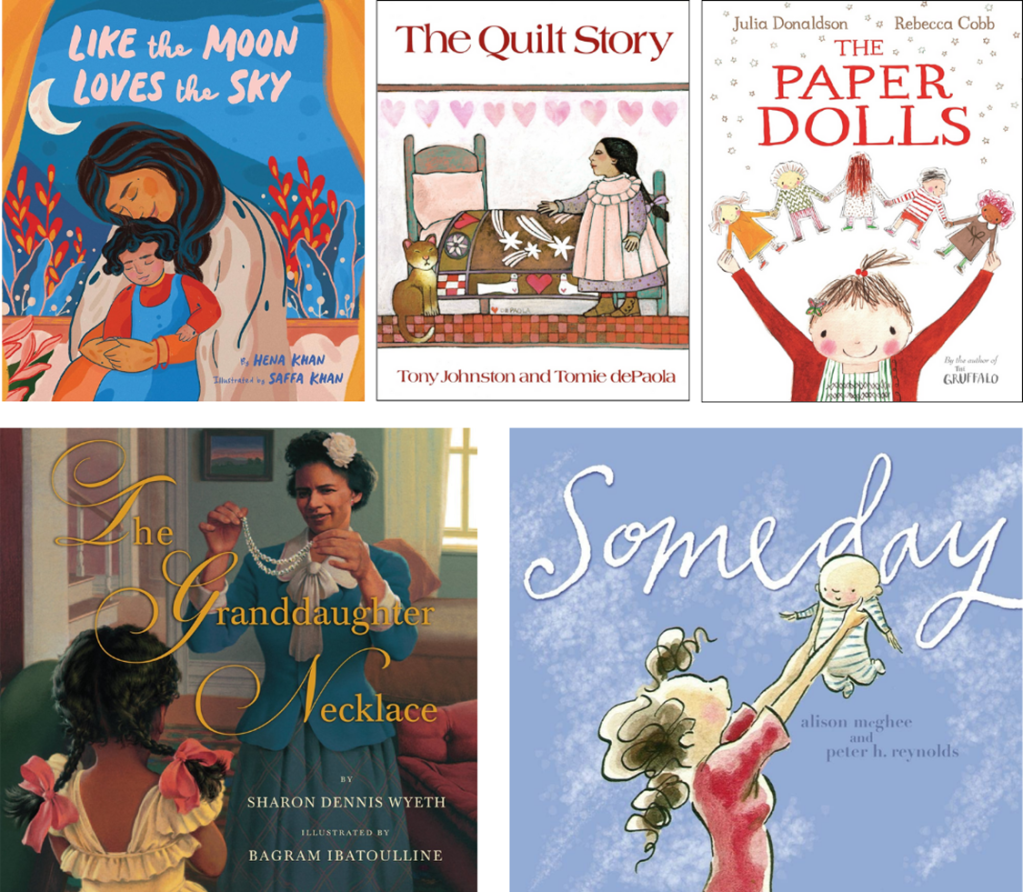
The picture books included in this category focus on the wisdom, expectations, values, or material elements that pass from one generation to the next as a signifier of connection or identity. Two of the picture books— Like the Moon Loves the Sky and Someday— centre around a mother’s monologue, revealing her hopes and the known paths they envision for their daughters’ lives. These intimate dialogues create a feeling that many of her desires come from the mother’s own life experiences, while simultaneously expressing an enduring bond and a vision of a wiser approach to life.
On the other hand, in The Quilt Story, The Granddaughter Necklace, and The Paper Dolls, as the titles suggest, a quilt, a necklace, and the tradition of making paper dolls are passed from one generation to the next. These material elements serve as symbols of tradition, connection, and history, bringing strength, comfort, and joy to those who inherit them.
6. Identity construction
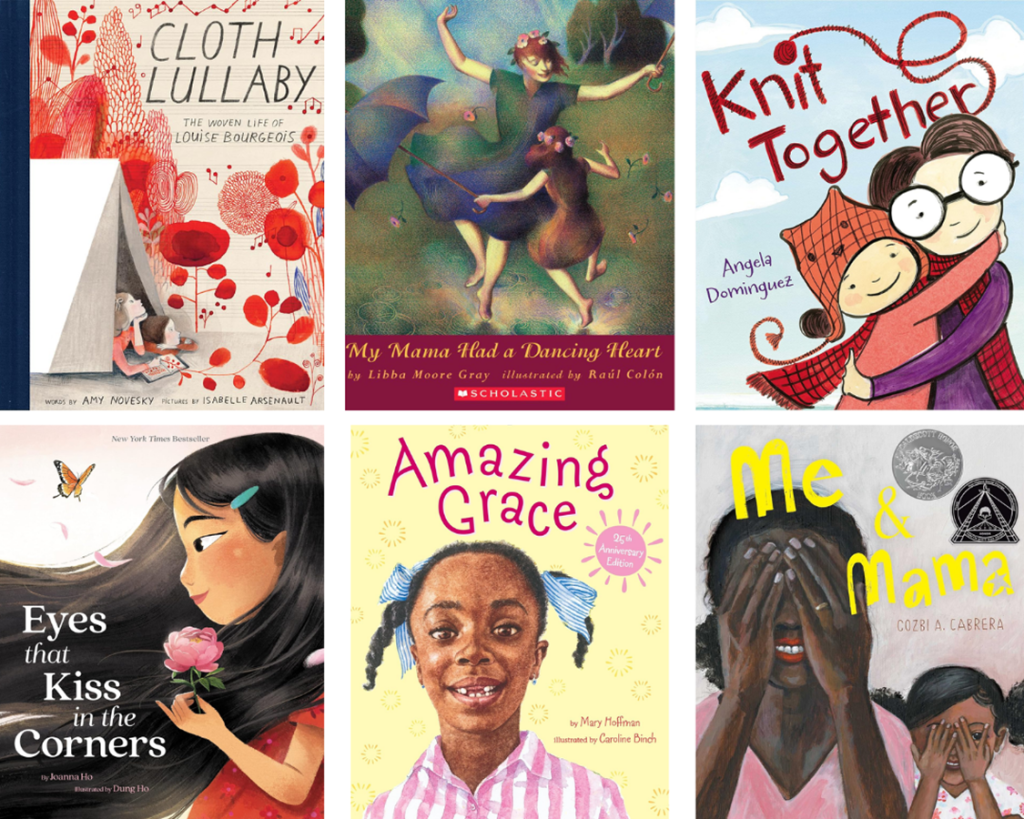
This category of picture books highlights the depiction of mothers who inspire or serve as role models for their daughters, guiding them on their journey of self-discovery and acceptance. In Cloth Lullaby: The Woven Life of Louise Bourgeois and My Mama Had a Dancing Heart, the daughters learn the art of weaving and dancing from their mothers, using these skills as inspiration to build careers in art and ballet dancing, respectively. In Eyes That Kiss in the Corners, an Asian girl learns to love her eyes by seeing the beauty and grace reflected in her mother’s and grandmother’s eyes. In Amazing Grace, a mother and a grandmother inspire the child to persevere in her dream of playing Peter Pan in her school’s play. Finally, in Knit Together and Me & Mama, the daughters try to follow their mother’s interests and passions but come to realize that while their tastes and skills may differ, their bond remains unbreakable.
Even though full intergenerational solidarity in children’s literature may be considered unattainable, it is hoped that the selected picture books will resonate with both the mother and the children. These books aim to provide a safe space for exploring the mother-daughter bond, while also offering mothers an opportunity to express their feelings, challenges, and expectations. Additionally, they serve as a platform for mothers to mediate the emerging questions their daughters may have about becoming women, or even a mother.
Bibliography
- Bishop, R.S. (1990) Mirrors, Windows and Sliding Glass Doors. Perspectives: Choosing and Using Books for the Classroom, 6(3): ix-xi.
- Cixous, H., Cohen, K., & Cohen, P. (1976). The laugh of the medusa. Signs, 1(4), 875–893. https://doi.org/10.1086/493306
- McAdam, J., Abou Ghaida, S., Arizpe, E., Hirsu, L.and Motawy, Y. (2020) Children’s literature in critical contexts of displacement: exploring the value of hope. Education Sciences, 10(12), 383.
- Nikolajeva, M. (2002). The rhetoric of character in children’s literature. Scarecrow Press, Incorporated.
- Trites, R.S. (1997), Waking Sleeping Beauty: Feminist Voices in Children’s Novels. Iowa: University of Iowa Press
 SLIDING MAGAZINE
Leave a comment