

Interactivity recalls for an active reader who engages with the elements of the book, who open envelopes, slide pieces, pull tabs; in other words, one who plays with the materiality of the book to co-create the story. Here, I present four books in English and/or Spanish that require an agentic and curious reader to bring their narratives to life.
Curiosity is an essential trait of being a human. Since babies, we have been discovering the world and learning about it through our senses . In that aspect, books can entice our need for stimulus with something more than letters and colours.
When we open a children’s book, we are expecting words and images. Depending on the work, the interaction between illustrations and text varies in complexity. Is the reader’s task to confront the semiotic relation between both and decipher it to make sense of the narrative. Picturebooks are a great example of this! (Just try to read Bear Hunt by Anthony Brown taking turns between reading just the text and just the images. It does not work). Still, some editorial products in the twenty-first century decided to go further in this multimodal relationship and include interactive elements in their products.
What does “interactivity” mean for books? The concept refers to the exchange between two or more entities to produce a certain result. In this case, the way in which the reader must approach the book to be able to understand the story. Interactive books might also be understood as playable media (Reid-Walsh, 2017) since they demand an active engagement of the reader with the product beyond that of turning pages. Interactive books are made so the reader must act to discover – or even co-create – the narrative.
As relevant as its function is its design. Movable books, also called pop-ups, rely on the physical, visual, and textual dimensions of the book. Pop-up books require not only cognitive, but also tactile and visual engagement from the reader (Serafini and Moses, 2022). Furthermore, the reader must interact with the elements of the book to build the story; if they don’t pull the tabs, open envelopes, or turn wheels, the narrative is incomplete.
Interactive books are made so the reader must act to discover – or even co-create – the narrative
Digital media like iBooks and narrative games also rely on interactivity to create the story. Reader agency is thus a central part of the design of the product (Eaton, 2014), as well as in the movable books. In this article, however, the focus will be on analogue books: personally, I think there is something special in the materiality (and artistry!) of these.
With interactive books, the great part comes when you acquire them (loan from a library, bought in a bookshop, lent by a friend, given by family) without knowing what they are, or what to expect. And surprise! You have to actually read them, invest time and attention, to “activate” the mechanisms and thus “build” the story. Of course, the modes of interaction differ between books considering a range of factors: year of publication, implied reader, materiality of the product, design idea, editorial, among others. In the next section, I will present some of my favourite interactive books, available in Spanish and/or English.
1. Cinderella: The Fairytale Files by Alan Durant (2008; English)
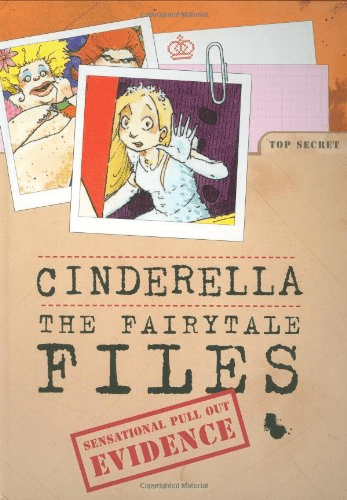
Yes, we already know Cinderella. Why would you read this book then, if you can narrate the story by memory? Well, this book reveals the more functional side of marrying a complete stranger when you are royalty!
Political intrigue, detective work, and a little bit of gossip form this interactive book. Rumple Stiltskin, a very famous investigator (you will be picking up references throughout the whole book) is sent to investigate the true story of Cinderella. Her real identity, the castle’s cautiousness, the scandal of announcing a marriage on a dancefloor, and more, are revealed through a lengthy investigation. The reader has access to all the documents gathered by Stiltskin, and so they must open envelopes, check newspaper cuts, compare photographs, and more to make sense of the narrative. The reader, then, fulfils the role of a co-detective in the process of truth.
Don’t worry, this is still a fairytale, so we can imagine the ending. However, you can play with the “what ifs” that arise during the investigation!
2. Nocturno. Recetario de Sueños by Isol (2011; Spanish)
Fondo de Cultura Económica (FCE)©
This picturebook (whose translated title would be Nocturnal. Dreams’ Recipe Book) features one of my favourite design motives behind it: Isol, the author, creates a sketchbook-like book that can only be activated with a lantern placed in front of the illustrations to charge the photosensitive ink, then turning off the lights so the images can glow in the darkness – all to inspire a sleep session full of adventurous dreams.
After a prologue that invites you to go to bed, the reader must choose one dream recipe for the night and discover the story setting lying behind a seemingly simple scene described with only one sentence (which is great to access the textual content of the book if you don’t speak Spanish! Translating a phrase has never been easier).
Empty rooms, quiet waters and grass-covered hills are some of the landscapes transformed into marvellous adventures by the flick of the light. My favourite? The artist one.
3. ¡Puf! / Poop! by Beatriz Giménez de Ory and Carles Ballesteros (2018/2020; Spanish/English)
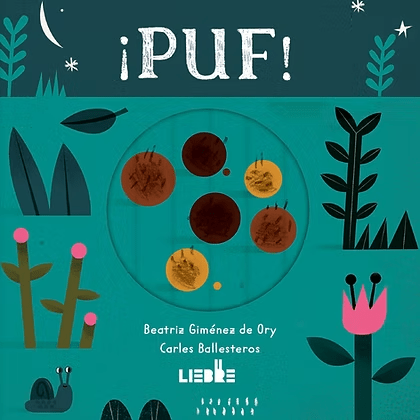
¡Puf! (in Spanish) and Poop! (English) offer an interactive alternative to informational books for early readers in the form of adivinanzas/riddles. With verses playing with the senses, referring to smell, colour and size of different animals’ faeces, the reader must discover the clues to find the solution to the enigma: whose poop is this?! When the reader is ready, they can turn the page to activate the sliding pop-up mechanism and reveal the illustration of the respective animal.
A playable book, with riddles about animals and poops? Let’s be honest, it doesn’t get better than this.
4. Los Superhéroes Odian las Alcachofas by Sebastián Pérez and Benjamin Lacombe (2015; Spanish)
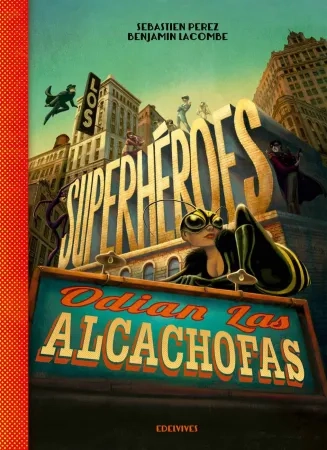
This title translates, literally, as Superheroes Hate Artichokes, which I think is a phenomenal form of picking up the attention of a potential reader. When you open this heavy album, you promptly realise that you are in front of an uncommon book: it’s full of optical illusions (that require you to use the 3-D glasses attached to the interior back cover to see the illustrations!). The text and images are merged on most of the pages, which present the reader with a postmodern call to action full of superhero propaganda (it even has a section of animal sidekicks and abilities to choose from) in different genres (newspaper cuts, biographies, posters, among others). At first glance, interactivity is not obvious; but, to decipher the pictures, the reader must turn back and forth through some of the pages while using the glasses to reveal the content.
These four books are addressed to children. They are an open invitation to engage with the materiality of the product and discover the possibilities brought by interaction and imagination. As mediators, however, we can also enjoy the excitement and the invitation to play with this media, as well as keeping our eyes open for books that motivate our curiosity and desire to explore the world of fiction. To be honest, we all like surprises.
Bibliography
- Eaton, A. (2014). “The Interactive Picturebook: Mapping ‘Literacy’ on a Narrative/Technology Continuum”. Fusion Journal, 5(1), web.
- Reid-Walsh, J. (2017). Interactive Books. Playful Media before Pop-Ups. Routledge.
- Serafini, F. and Moses, L. (2022) “An Analysis of the Semiotic Resources of Contemporary Movable Picturebooks”. Bookbird: A Journal of International Children’s Literature, 61(2), pp. 26-36.
 SLIDING MAGAZINE
Leave a comment