

Lesbian fanfiction and the case of #Supercorp
With the exponential surge of technology and mixed media, the interaction between the public and the stories they connect with has changed significantly. Especially the involvement of the internet allows fan communities to expand and interact with each other in diverse ways. Within internet platforms, fans not only share interests and opinions about the diverse media they consume but also appropriate it in ways that allow them to change or widen the world and characters that inhabit these narratives.
Fanfiction has been a prolific practice in fan circles, using platforms such as Fanfiction.net, AO3, and Tumblr, to name the most famous ones. Here, fans develop and comment on different headcanons and ships –the majority involving various types of queer representation– which are rooted in the interactions within fan communities, their interpretation, and re-appropriation of the stories. As young people develop their interpretations of the world and its characters, their opinions and previous experiences take centre stage, allowing them to relate and rethink their appreciation of the canon. Some of the most well-known ships are Remus Lupin and Sirius Black (aka Wolfstar) from the Harry Potter series, Stiles Stilinski and Derek Hale (Sterek) from Teen Wolf, Sherlock and John Watson (Johnlock) from BBC’s Sherlock series, and Dean and Cas (Destiel) from Supernatural. These ships show clear evidence of the importance placed on queer representation within fan circles, and the attention placed predominantly on male relationships.
It could be said that mainstream media has evolved regarding queer representation as characters challenge cis- and heteronormativity. But there are still differences between cis-male and cis-female representation, as well as lesbian representation. Gay male characters are overshadowing sapphic ones. Not only that: although YA literature has come to offer strong, outspoken female characters, they lack diversity. They tend to be thin, white, able-bodied girls with a distinguishable feminine presentation. Which raises the question, how do queer girls respond to the lack of representation in the media? Where is the diversity of lesbian gender expressions?
Queer girls and women have commented on the often superficial, and even lacking representation of lesbian relationships in the media. Outwardly queer feminine protagonists are not common, and the canonical confirmed ones often reproduce stereotypes, are stylised to be very gender-defined characters, and even fall victim to the ‘bury your gays’ trope. Rebecca Sugar, creator of Steven Universe, has confirmed the difficulties she faced to be allowed to include lesbian relationships in her show, being catalogued as ‘inappropriate’.
As a response, young lesbian fans have expressed their frustrations about not being included in the stories they love. Instead, they have taken it upon themselves to generate the representation they desire. Queer girls take back their power as consumers of these stories by creating headcanons and fanfiction, often strengthening the world these narratives take place. But mainly, fan practices enable teen lesbians to reinterpret, dismantle, and rebuild the canon in favour of the representation they desire: to create a real sense of belonging within these worlds. They can see and acknowledge the issues put forward in media, yet they also call out the missing pieces and the need for more nuanced and complex understandings of their identities, as well as the role that sexuality entails in their sense of self.
With these critical fan practices, girls are taking a stance and defying the implied norms by adults, not only by calling them out, but constructing more inclusive narratives by and for themselves through fanfiction. Young lesbians are openly and actively pushing against the dominant culture that often marginalises them, using their fan practices and circles as spaces for resistance. They are aware of the outside institutions that hold power over them, silencing or ignoring queer representation and react to them by pushing these stories by themselves.
Based on the interactions between characters and their own experiences and desires, queer girls recognize feelings and interactions they relate to, to what being a young lesbian feels like. And hopefully, these characters will have something deeper than just friendly interactions, and can -ideally build a romantic relationship.
Supergirl’s finale presents a relevant example of a reactionary practice carried out by the fandom and the ship Supercorp. It consists of Supergirl Kara Danvers and Lena Luthor, and has currently over 20,300 works of fanfiction on AO3. Unsatisfied with the canon ending, fans took to Twitter to correct the final scene. Although this ship falls into the white, thin, able-bodied and rather feminine mould for relationships: the case offers an interesting example for the impact of fans voices online.
Throughout the run of the show, Kara and Lena’s friendship had been numerously called out for queerbaiting, using tropes commonly assigned to build up heteronormative romantic pairings to build up their connection. In one episode, Lena leaves flowers in Kara’s office and says to her: ‘‘Supergirl may have saved me but Kara Danvers, you are my hero.’’
These types of interactions lasted throughout five seasons of the show and culminated in the series finale in 2021. After Kara’s talk with her mentor about living life as her true self, Kara and Lena have a deep and life-altering conversation while holding hands and longingly staring into each other’s eyes… only for them to declare their meaningful friendship. This caused multiple reactions in the fandom, and the shippers of Supercorp headed to X (then Twitter) to express their emotions towards the end of the show. But more importantly, they decided to ignore and reimagine its conclusion. The fans took different approaches to this alternative ending by editing videos and images, or just tweeting out their comments; but they all agreed that Kara and Lena finally kissed, admitting their true feelings for each other. The hashtag Supercorp was trending for 24 hours on X.
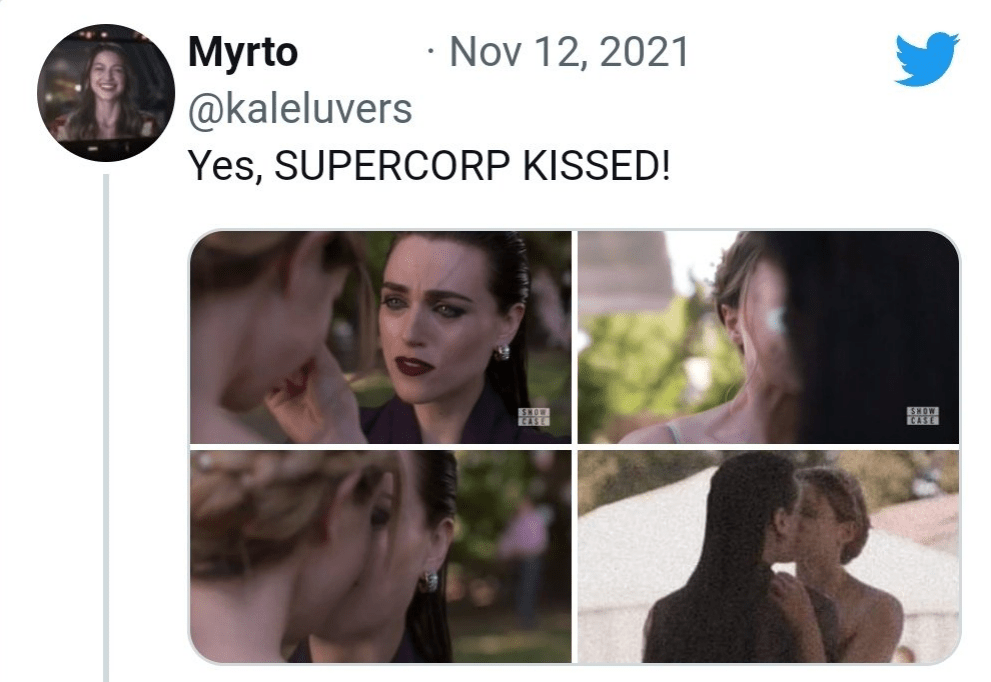
This is a case of radical queer reappropriation. Young people rewrote –or gaslit– the finale of a show famous for never committing to the blatant lesbian insinuations of its main characters. It showed the commitment, exhaustion, and anger of queer young girls, who have continuously been misrepresented and silenced.
As fans, lesbian girls and young people are re-shaping these fictional worlds into spaces where all aspects of themselves and the complexities of queerness and queer culture can exist openly, proudly, and lovingly.
Bibliography
- Church, J. (2023) #Supercorp kissed…or did they?: lesbian fandom and queerbaiting, Journal of Lesbian Studies, 27:2, 213-229, DOI: 10.1080/10894160.2023.2176973
- Friedman, E.C. 2024, “What We Talk about When We Talk about Fanfiction”, Eighteenth-century fiction, vol. 36, no. 1, pp. 159-168.
- Green-Barteet, M. A., & Coste, J. (2019). Non-normative Bodies, Queer Identities. Girlhood Studies, 12(1), 82–97. https://doi.org/10.3167/ghs.2019.120108
- Greenblatt, E. (2011). Literature from the Heart. Journal of LGBT Youth, 8(1), 99–102. https://doi.org/10.1080/19361653.2011.520566
- Haug, O. (2023) In the Book Ban Era, Queer Representation on Kids’ TV Is More Important Than Ever, Them. Available at: https://www.them.us/story/lgbtq-childrens-tv-representation (Accessed: 21 March 2024).
- Talburt, S. (2022). Mary Robertson, Growing Up Queer: Kids and the Remaking of LGBTQ Identity. Sexualities, 25(3), 301–303. https://doi.org/10.1177/1363460720957199
- Trites, R.S. (2000) Chapter Title: ‘Do I dare disturb the universe?’ ADOLESCENT LITERATURE IN THE POSTMODERN ERA. Disturbing the Universe: Power and Repression in Adolescent Literature.
- Scahill, A. (2019) ‘Fanfic’ing Film’, Girlhood Studies, 12(1), pp. 114–124. Available at: https://doi.org/10.3167/ghs.2019.120110.
- Shetty, P. (2020). Young People’s Agency in Online Fan Spaces. Childhood, Agency, and Fantasy: Walking in Other Worlds, 173.
 SLIDING MAGAZINE
Leave a comment